Expert Q&A
25.05.26
Expert Q&A: Rethink your approach to paediatric URTIs – practical advice from Dr Jonny Taitz

Think upper respiratory tract infections (URTIs) in young children are run of the mill? Pressure from parents and caregivers for a prescription-based solution, and the time required to provide reassurance that recurrent presentations are normal, can challenge even the most experienced physicians.
In this article, paediatrician Dr Jonny Taitz shares his insights on how to effectively and efficiently conduct these frequent consultations.
Q: Why are URTIs in preschool‑aged children such a frequent feature of general practice?
It’s important to know that it can be normal for preschool-aged children in childcare to have six to eight URTIs each year.1 There are a few factors at play here. Firstly, babies and young children have an underdeveloped immune system.2 Secondly, transmission of viral infections among children at childcare is common,3 as often children attend daycare or preschool while infectious. And so sometimes it feels like it’s a merry-go-round: a kid gets sick, goes home for a few days, comes back, gets sick from the next kid, and so on.
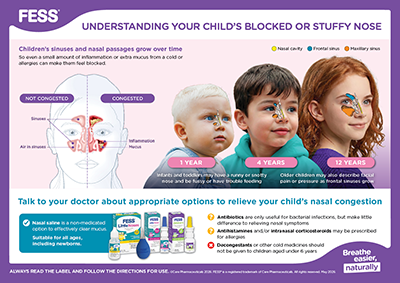
Anatomy also plays a role, as children’s sinonasal anatomy is very underdeveloped compared to adults, meaning that their airways can get blocked and congested more easily.4 So the exposure risk at childcare, combined with underdeveloped immunity and airway anatomy can heighten the risk for developing URTIs in preschoolers.
Key takeaway:
Frequent URTIs are an expected part of children’s development in the first few years of life. For GPs, it’s essential to distinguish complicated presentations from the straightforward ones.
Q: How do you approach URTI assessment in young children, and when does it warrant further evaluation?
The most important thing is to assess the overall wellbeing of the child, starting with level of consciousness and their fluid intake and output over the previous 24 hours. Examine their chest and upper airway for congestion and look for any concerning features.4
The big three flags for an emergency presentation would be an unexplained rapid heart rate, persistent high respiratory rate, and lethargy.4 Other key signs include a returning high temperature after its settled, or a high temperature that lasts more than 5 to 7 days, because that would raise concern about a secondary bacterial infection.5
There are certain children who may be at greater risk of more severe URTIs or complications. Consider further assessment or closer follow-up in babies born prematurely, young children with underlying cardiac or respiratory conditions (e.g., cystic fibrosis), those with known or suspected immunodeficiency, and those with prior lengthy or complicated hospital stays.4
Luckily, most cases GPs will see are uncomplicated,5 but for those that are less straightforward or the GP is not sure, the gold standard of care is to ensure timely follow-up. That might be a phone call at the end of the day, getting them back the next day, or clear instructions for the parents on when to present. Particularly, ensure that parents from a non-English speaking or disadvantaged background know what to do and where to present, as sometimes that does get lost in translation.
Key takeaway:
Be alert for signs of severe illness or secondary bacterial infection, especially in at-risk children.4,5 Timely follow-up is a simple yet powerful behaviour to support safety netting.
Q: How do you approach recommending symptomatic therapy options for young children in URTI consultations?
Most babies and young children who come in are doing fine, so management is largely around reassurance for the parents and recommending supportive care. First, I recommend fluids. I say don’t stress about solids, because sick babies won’t eat; but keep up fluid intake, especially electrolyte-balanced solution, and monitor wet nappies.
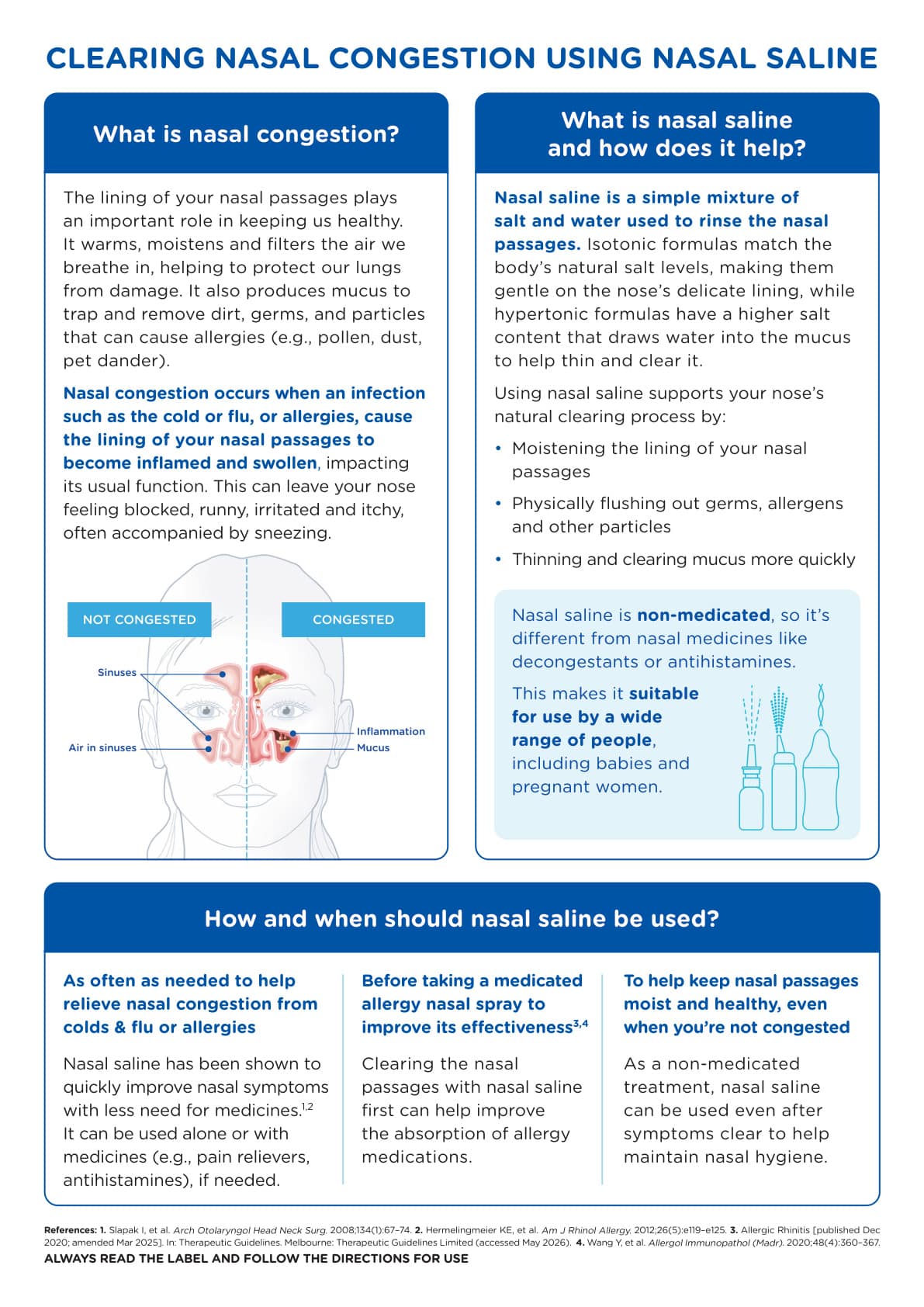
Relieving nasal congestion is the other main thing to recommend to parents. Using nasal saline to clear out nasal passages and sinuses is very important, especially before feeding.4 It tends to be underutilised, as some people don’t feel that it can be used to treat nasal congestion, when in fact, studies show that it’s an effective and low-risk intervention.6,7 So nasal saline plays an important role in symptom relief, especially in infants and children under 6 years of age for whom medicated decongestant options are limited.5
I also stress the role of immunisation. While you can’t stop kids getting viruses, you can immunise where appropriate and take preventive measures. The flu vaccine is recommended annually for all eligible children over 6 months of age (now available in nasal administration) and RSV immunisation is also available for eligible young children.8,9
Key takeaway:
Nonpharmacologic care with nasal saline and fluids, and preventive care with immunisation, extend the GP’s toolbox to help manage frequent URTIs in children.4-9
Q: How do you handle situations where parents feel something ‘more’ should be done for their child?
Some parents will insist on a swab to test for the source of infection, which we will do sometimes depending on the child’s background. But whether the URTI is caused by a rhinovirus, influenza, or parainfluenza – or not, it doesn’t really change patient management. Most URTI care involves symptomatic treatment.
Unfortunately, we live in an era where many doctors feel that they have to prescribe an antibiotic for what is almost always a viral infection, which is just increasing antibiotic resistance. Addressing this issue requires reassurance and education.
Explain to parents the difference between viral and bacterial infections, and that antibiotics will do nothing to a virus. So, in the absence of red flags or concerns around sepsis, there’s no indication for an antibiotic. Sometimes there are demands from parents for antibiotics, but if you take the time to explain why, most parents are not keen to have inappropriate antibiotics either.
Key takeaway:
Managing antibiotic expectations with empathy, education, and a clear symptomatic management plan can help families feel informed and supported.
Q: What practical advice do you usually give families when discussing management options?
When recommending nasal saline, it’s important that parents understand that there are age-specific products available. Due to changes in sinonasal anatomy over time, nasal saline drops will work better for infants and very young children, while nasal saline sprays will work better for older children.10,11 Simple education for parents can help them understand their options and select the right nasal saline for their child. Also, make sure you explain to parents how to correctly position the nozzle to effectively administer the nasal saline drops or spray into the nasal cavity.11 Samples are always handy to have available to help with this.
It’s also important to cover what red flags parents should look out for, so they know when they need to seek urgent medical care. Key concerning features in children under 3 years include lethargy, reduced fluid intake and urine output (i.e., few wet nappies), rapid heart rate, rapid breathing or increased work of breathing (recession), and altered consciousness.4,5 I tell parents to trust their intuition – their child may look fine now, but things can change in 6 or 12 hours, and they should visit the emergency department or 24/7 urgent care centre if they deteriorate.
Key takeaway:
Advise on age-appropriate nasal saline options and correct administration to ensure efficacy.11 Clear, concrete instructions can help parents feel confident managing symptoms at home and knowing when to take further action.
Q: If there is one thing GPs could do to improve how they approach paediatric URTI consultations, what would it be?
Follow the three pillars of symptomatic therapy, education, and immunisation. Prescribe fewer antibiotics and recommend more nasal saline, because it provides symptomatic relief and can help reduce the length of infection.

About the expert
Dr Jonny Taitz is a Specialist General Paediatrician in private practice in Sydney’s Eastern Suburbs, caring for children with both complex and simple medical issues. Dr Taitz is a Senior National Examiner for the Royal Australasian College of Paediatricians and is a Conjoint Senior Lecturer at the University of NSW. He has previously served as the clinical adviser to the Paediatric Patient Safety program at the NSW Clinical Excellence Commission and on the editorial board of the British Medical Journal Quality and Safety. Dr Taitz completed his paediatric training at Red Cross Children’s Hospital in Cape Town and at Sydney Children’s Hospital, Randwick, where he then worked as a Consultant Paediatrician and Assistant Director of Clinical Operations. His previous roles also include Director of Medical Services at Royal North Shore Hospital and acting Executive Director of Medical Services for Northern Sydney Local Health District. He was awarded a Harkness Fellowship in quality and safety and spent a year at Harvard Medical School in Boston. Dr Taitz has authored two books: the Australian Kids Health Book: The Essential A-Z Guide to Emergencies, Baby Care and Common Childhood Illnesses and the New Zealand Kids Health Book: The Essential A-Z Guide to Emergencies, Baby Care and Common Childhood Illnesses.
GP, general practitioner; NSW, New South Wales; RSV, respiratory syncytial virus; URTI, upper respiratory tract infection.
References:
- Pappas DE. The common cold in children: Clinical features and diagnosis. Updated January 2025. In: Edwards MS (Ed). UpToDate®. Wolters Kluwer.
- Beran J, et al. Primary Care Respir Med. 2025;35:49.
- Cardinale F, et al. Global Pediatr. 2024(8):100105.
- Albishi NS, et al. J Med Chem Sci. 2024;7:1047–1860.
- Acute rhinosinusitis [published Mar 2025]. In: Therapeutic Guidelines. Melbourne: Therapeutic Guidelines Limited (accessed May 2026).
- Cruz M, et al. Cureus. 2024;16(12):e75464.
- Slapak I, et al. Arch Otolaryngol Head Neck Surg. 2008;134(1):67–74.
- Australian Technical Advisory Group on Immunisation (ATAGI). Statement on the administration of seasonal influenza vaccines in 2026. Issued 27 February 2026. Available: https://www.health.gov.au/sites/default/files/2026-03/atagi-statement-on-the-administration-of-seasonal-influenza-vaccines-in-2026.pdf (accessed May 2026).
- Australian Technical Advisory Group on Immunisation (ATAGI). Respiratory syncytial virus (RSV). In: Australian Immunisation Handbook, Australian Government Department of Health and Aged Care, Canberra; 2024. Available: immunisationhandbook.health.gov.au (accessed May 2026).
- Badr DT, et al. Curr Treat Options Allergy. 2016;3(3):268–281.
- Sawant N, Donovan MD. Pharm Res. 2018;35(5):108.
©Care Pharmaceuticals 2026. FESS® is a registered trademark of Care Pharmaceuticals. All rights reserved. May 2026.
This information is intended for use by healthcare professionals only.