Expert tips
22.09.2025
Top 4 expert tips to optimise allergic rhinitis management, with Dr Jessica Tattersall

Dr Jessica Tattersall is an allergist and medical rhinologist with extensive experience in allergic, non-allergic and inflammatory diseases of the airway and sinuses. Drawing on clinical guidelines and her specialist experience, read on for her practical advice on how GPs can support patients with nasal symptoms this allergy season.
Tip 1: When it comes to congestion – ditch the tablets, focus on topicals
Oral non-sedating or intranasal antihistamines are recommended as first-line treatment for intermittent mild allergic rhinitis symptoms, while intranasal corticosteroids (INCS) or combination INCS/antihistamine sprays are preferred for persistent and/or moderate-to-severe presentations.1,2
Antihistamines can be effective for sneezing, rhinorrhoea and ocular symptoms.1,2 However, for nasal congestion – which has been reported by allergy sufferers as the most bothersome symptom – INCS, either alone or as a combination INCS/antihistamine, provides more effective relief than antihistamines.1–4
Dr Tattersall explains: “Combination sprays are superior for symptom control, however these medications are privately funded and cost must come into consideration. A single-agent INCS is still a better choice than an oral antihistamine tablet.”
Tip 2: Don’t be afraid of long-term INCS use
While INCS are more effective than antihistamines for relieving allergic rhinoconjunctivitis symptoms, their use can very rarely be associated with local adverse effects such as epistaxis and nasal dryness (but importantly, not nasal atrophy).1,2 These effects are uncommon when INCS are administered correctly, and systemic absorption of INCS is also negligible when used at recommended doses.1 Teaching correct use of a nasal spray is therefore essential, as correct technique and adherence are key to balancing safety and efficacy.2
Dr Tattersall suggests: “Demonstrate to patients that they should point the nasal spray tip in the nostril towards the lateral wall of the nose. They should then ‘sniff’ as they spray, but not so hard that it ends up going down the back of their throat, where it’s wasted. It’s about controlling that sniff, so the medicine stays in their nose.”
Duration of treatment should then be tailored to the patient’s symptoms – seasonal sufferers may only require treatment pre- or co-seasonally, but long-term regular use is recommended for persistent perennial allergies, if effective.1,2
Dr Tattersall recommends: “Patients can get the most out of their INCS if they use it as a preventer, which means regularly and at its recommended dose. Doctors should feel confident that regular use is not associated with adverse outcomes over the long-term. So, if it’s working, there’s no need to discontinue use.”
Tip 3: Clear the way first with nasal saline
Nasal saline helps physically cleanse the nasal passages by flushing out mucus, debris, allergens and pollutants, and may improve mucociliary clearance by enhancing ciliary beat frequency, thereby supporting nasal function.1,5 It is generally considered well tolerated and effective for reducing nasal symptoms, and is recommended as an adjunct to pharmacotherapy for all presentations of allergic rhinitis.1,2
In fact, pre-treatment with nasal saline can help to improve effectiveness of medicated intranasal sprays.6 In a systematic review and meta-analysis of randomised controlled trials, it was found that use of nasal saline irrigation as an adjunct treatment decreased nasal symptoms of allergic rhinitis in adults and children by 28%, accelerated mucociliary clearance by 31%, and reduced medication use by 62%.5
Dr Tattersall recommends her patients use nasal saline at least a few minutes before administering a nasal spray for allergic rhinitis, and explains that there are several format options available that can be tailored to different needs and preferences. “Sprays are a great choice because they are easy and portable, and you don’t always need high volume irrigation to have a good effect,” says Dr Tattersall.
When it comes to nasal rinses, she emphasises the importance of technique. “Technique is a huge factor. The vast majority of patients get put off because they’re not doing it correctly, they irrigate too forcefully and it just feels like it’s drowning them. So, it’s important to show them how to actually do it, in a calming fashion, gently up one nostril and down the other. I’ve found when they get it right, it ends up being very effective and they don’t dread doing it.”
Tip 4: Better control for allergic rhinitis means better control of asthma
Allergic rhinitis and asthma frequently coexist. Asthma develops in up to 30% of patients with allergic rhinitis, while allergic rhinitis develops in up to 80% of those with asthma.1,2 Because both conditions share common inflammatory pathways, it has been suggested that effective treatment of allergic rhinitis may improve asthma control.1 So, it’s important for clinicians to consider and manage both conditions simultaneously in relevant patients.1
“A combination INCS and antihistamine spray is still the ideal first-line treatment for any patient with allergic rhinitis, regardless of whether they have asthma or not,” Dr Tattersall says “The key thing to keep in mind is that both conditions benefit from preventative therapy – so it’s important to reinforce the need for regular use of the medicines they are prescribed.”
Indeed, if there’s one thing that Dr Tattersall wants GPs to take away, it’s to recommend regular use of intranasal corticosteroid sprays whenever possible. “An INCS with or without the antihistamine is by far the most effective treatment for allergic rhinitis, and the newer generations have been shown to be safe for long-term use. I really recommend GPs encourage their patients towards regular use for the best possible outcomes, and pairing with nasal saline will also help them get the most out of the medication.”
About the expert

Dr Jessica Tattersall is an allergist and medical rhinologist. She graduated from the University of Sydney with honours in 2003 and began her career training in otolaryngology before pursuing a career in allergic diseases. She is a Fellow of the Royal Australian College of General Practitioners and holds a Masters of Medicine in Allergic Diseases from the University of Western Sydney. During her training, she worked as a clinical research fellow at the John Radcliffe Hospital in the Department of Otolaryngology in Oxford. She is a senior clinical lecturer in the Faculty of Medicine at the University of Sydney.
Dr Tattersall has a special interest in allergic, non-allergic and inflammatory diseases of the airway and sinuses and is actively involved in research and education in this field. She is a member of the Australasian Society of Clinical Immunology and Allergy, the Australian and New Zealand Rhinological Society, and the American Rhinological Society.
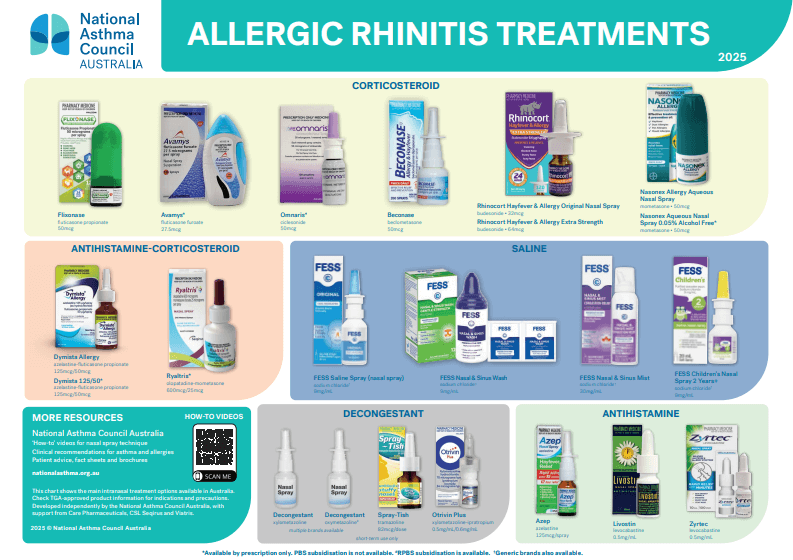
Download the National Asthma Council Allergic Rhinitis Treatment Chart
A guide to the main intranasal treatment options currently available in Australia
To download this resource, please login or register.
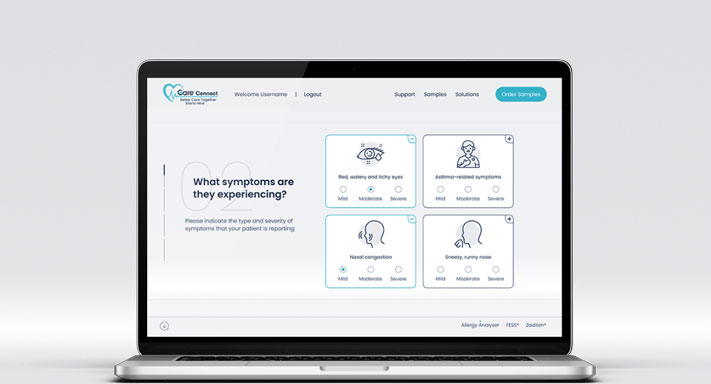
Allergy Analyser
Access the Allergy Analyser to create a personalised allergy treatment recommendation for your patients
Please login or register to gain free access to Care Connect.
Please login or register to gain free access to Care Connect.
References:
- Australian Society of Clinical Immunology and Allergy (ASCIA). Allergic Rhinitis Clinical Update 2024. Available from: https://www.allergy.org.au/hp/papers/allergic-rhinitis-clinical-update (accessed September 2025).
- Allergic rhinitis [published 2020 Dec; amended 2025 Mar]. In: Therapeutic Guidelines. Melbourne: Therapeutic Guidelines Limited; accessed September 2025.
- Stewart M et al. Int J Gen Med. 2010; 3:37–45.
- Meltzer EO, et al. Allergy Asthma Proc. 2012;33 Suppl 1:S113–S141.
- Hermelingmeier KE, et al. Am J Rhinol Allergy. 2012;26(5):e119–e125.
- Wang Y, et al. Allergol Immunopathol (Madr). 2020;48(4):360–367.
©Care Pharmaceuticals 2025. FESS® is a registered trademark of Care Pharmaceuticals. All rights reserved. September 2025.
This information is intended for use by healthcare professionals only.