Nasal Health
03.11.2023
Clearing up the facts on obstructive sleep apnoea
Obstructive sleep apnoea (OSA) is a common sleep disorder characterised by repetitive partial or complete airway obstruction.1 Congestion associated with allergic rhinitis has been shown to be associated with increased risk of sleep disordered breathing.2 With allergy season in full swing and with the associated seasonal spike in allergic rhinitis cases, it is important to understand the facts around OSA to help your patients achieve a better night’s sleep.

The prevalence and burden of OSA is high in Australia1
OSA impacts approximately 780,000 Australians over the age of 15 years with the prevalence peaking between the ages of 45 and 75 years.1 This condition places a significant burden on patient quality of life and has been associated with increased risk of:1

Mental Symptoms
- Daytime sleepiness
- Depression

Cardiovascular Conditions
- Chronic heart failure
- Coronary artery disease
- Stroke

Injuries
- Motor vehicle accidents
- Workplace injuries
OSA also places a significant annual economic burden ($522 million between 2019 and 2020) on the healthcare system.1
Nasal congestion plays a significant role in the pathogenesis of OSA
Nasal congestion can be exacerbated by nasal inflammation and infection caused by allergic rhinitis or upper respiratory infection.2 A recent study demonstrated that people experiencing nasal congestion due to allergic rhinitis are 1.8 times more likely to suffer from moderate-to-severe sleep disordered breathing than those without nasal congestion.2
Continuous positive airway pressure is the standard treatment intervention into OSA3
Continuous positive airway pressure (CPAP) is considered the gold standard treatment in OSA.3 CPAP acts as a non-invasive splint of the airway by applying positive internal pressure and preventing pharyngeal collapse.3 CPAP can reduce symptom burden, increase quality of life and reduce the risk of clinical complications associated with OSA.3,4
However, nasal adverse events are commonly experienced by patients administered CPAP.3 These adverse events include:3,4
- Nasal dryness
- Nasal and sinus congestion
- Rhinorrhoea
- Inflammation
- Ciliary dysfunction
The FESS® range of non-medicated nasal products may help reduce nasal congestion and manage side effects of CPAP
The Fess® range of non-medicated nasal sprays, washes, gels, and dry nose oils offer symptom relief for patients suffering from nasal and sinus congestion and/or nasal dryness and irritation.
Think FESS® first for the relief of nasal congestion to help your patients sleep easier.
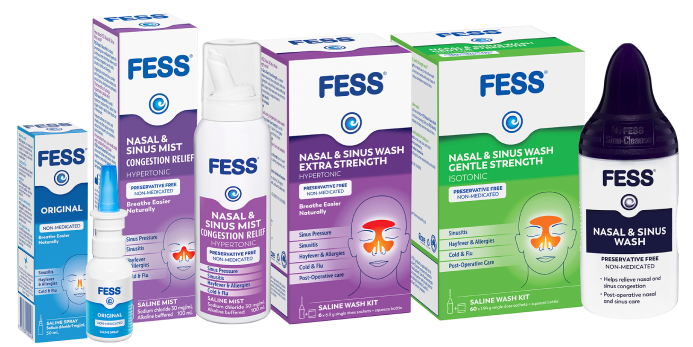
FESS® nasal sprays, mists, and washes thin, loosen, and clear mucus from the nasal passage to help relieve nasal and sinus congestion
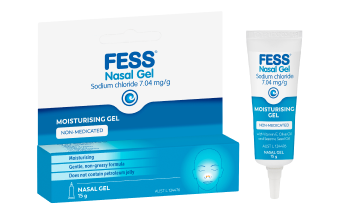
A gentle, non-greasy formulation, FESS® Nasal Gel contains vitamin E, olive oil, and sesame seed oil to help soothe, moisturise, and relieve dry, chafed, and inflamed noses.
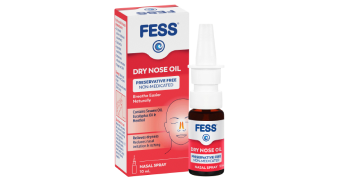
FESS® Dry Nose Oil Spray contains sesame oil, eucalyptus, and menthol to help lubricate dry nasal tissue and reduce nasal irritation and itching.
Did you know?
A recent study demonstrated that nasal saline irrigation resolved symptoms of sleep disordered breathing in 41% of children aged 3–12 years.5
FESS® is a proud partner of the Sleep Health Foundation, as part of our commitment to helping patients sleep easier.
Order your FESS® samples today
Abbreviations: CPAP, continuous positive airway pressure; OSA, obstructive sleep apnoea.
References: 1. Deloitte Access Economics (Deloitte) 2021. Rise and try to shine: the social and economic cost of sleep disorders in Australia. Blacktown, New South Wales: Sleep Health Foundation. 2. Kohler M, et al. Eur Respir J. 2007;30(6):1208–15. 3. Ghadiri M, et al. Respirology. 2020;25(6):593–602. 4. Koutsourelakis I, et al. Eur Respir J. 2011;37(3):587–94. 5. Baker A, et al. JAMA Pediatr. 2023;177(3):240–247.
This information is intended for use by healthcare professionals only.
FESS® is a registered trademark of Care Pharmaceuticals. All rights reserved. © Care Pharmaceuticals 2023.