
Allergy Eyes
30.08.2025
Can you spy the allergy eye?
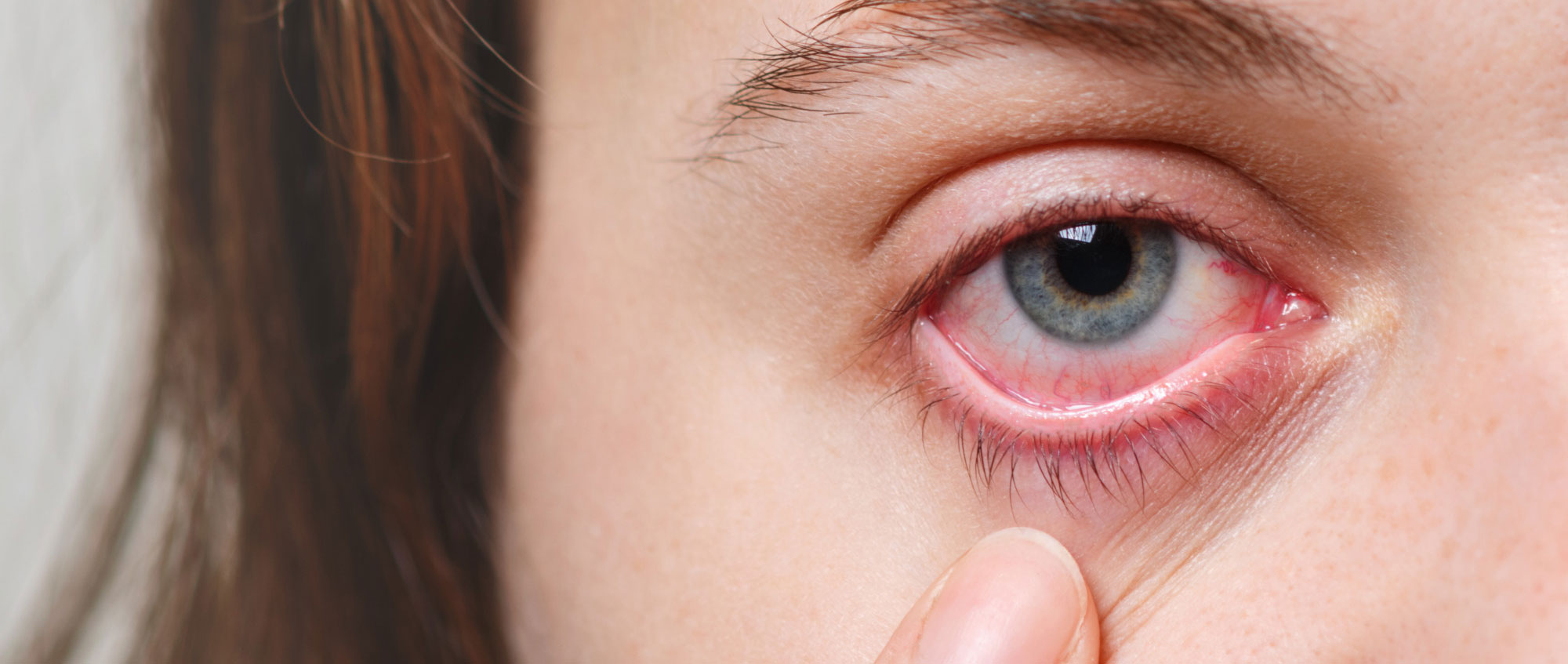
GPs may see several patients each week who present with red, watery eyes and discomfort, particularly during allergy season.1,2 But not all red eyes are ‘eye-dentical’ – from allergic responses to viral infections, distinguishing the underlying cause can be challenging.2 In fact, almost two-thirds of patients treated by GPs for red eye may not receive the correct diagnosis.1
So, do you have what it takes to crack the case of the red eye? Read on to test your diagnostic ‘eye-Q’ against others, and refresh your knowledge on key signs, symptoms, and targeted patient questions that can help you narrow down a diagnosis fast.
Test your skills: spot the allergy eye
When diagnosing ocular conditions, GPs must rely on their clinical judgement – and visual examination plays a key role. Do you think you can select the correct eye condition based on an image alone? Submit your answers below and discover how your red ‘eye-Q’ stacks up!

Uncovering the clues for conjunctivitis: three key questions to ask patients
Red eyes may look similar at first glance, but key clinical clues can help distinguish the underlying cause of acute red eye presentations:2
- Allergic conjunctivitis is typically bilateral, with intense itch and watery or mucoid discharge.
- Bacterial conjunctivitis often begins unilaterally but can become bilateral, accompanied by purulent discharge and eyelid crusting.
- Viral conjunctivitis is initially unilateral but tends to become bilateral within days, with watery discharge. It is frequently associated with a viral upper respiratory tract infection.
Summary of key clinical differences between common causes of red eye2,3
| Type | Typical onset | Key differentiating symptoms | Course |
|---|---|---|---|
| Allergic conjunctivitis |
|
|
|
| Bacterial conjunctivitis |
|
|
|
| Viral conjunctivitis |
|
|
|
When assessing patients who present with red eyes, consider asking these three questions to help you quickly reach the most likely diagnosis:2
- Are your eyes itchy? Suggests allergic conjunctivitis
- Do you have thick or sticky discharge that causes your eyelids to stick together? Suggests bacterial conjunctivitis
- Have you had a recent cold or flu? Suggests viral conjunctivitis
Why cracking the diagnosis matters: matching the treatment to the disease
The recommended treatments for conjunctivitis differ based on the underlying cause,2,3 so making an accurate diagnosis ensures that your patients receive the appropriate treatment for their condition.
Allergic conjunctivitis:
Oral antihistamines or intranasal corticosteroids may be recommended alongside saline eye drops or eye washes, particularly if there are also symptoms of allergic rhinitis. However, if the response is inadequate, medicated eye drops should be considered.4
Bacterial conjunctivitis:
While most cases resolve without treatment within 7 days, topical antibiotics (chloramphenicol or fremaycetin) may be considered in patients with marked symptoms (e.g., purulent discharge). Empirical treatment with aminoglycoside or quinolone eye drops is not recommended. Note the most common causes of bacterial conjunctivitis include Staphylococcus aureus, Streptococcus pneumoniae, and Haemophilus influenzae; chlamydial and gonococcal conjunctivitis require specific assessment and antibiotic treatment.2
Viral conjunctivitis:
Symptomatic management is recommended (regular cold compresses and lubricating eye drops), with symptoms usually resolving within 2 to 3 weeks. Due to its highly contagious nature, educate patients on measures to avoid spreading the infection, including hand hygiene, avoiding shared linens, and minimising contact with other people while symptomatic.2
Spotlight on allergy eye drops: when and what to recommend
While the main symptoms of allergic conjunctivitis can be relieved with an oral antihistamine, medicated eye drops offer a targeted treatment that can provide faster symptom relief.2,5 Consider recommending a medicated allergy eye drop in conjunction with an oral antihistamine to give your patients relief within a few minutes while they wait for the antihistamine to start working.
However, choice of medicated eye drop is important. Topical decongestants or vasoconstrictors (such as those containing naphazoline) are not recommended for allergic conjunctivitis because they risk rebound ocular redness, which can lead to potential overuse, and do not target the key symptom of itch.4,5
Luckily, there are several options recommended for allergic conjunctivitis:2
- Anthistamines (levocabastine 0.05%) provide rapid relief of symptoms.
- Mast cell stabilisers (cromoglycate 2%, lodoxamine 0.1%) take longer to work (up to two weeks) but provide sustained benefit.
- Agents with both antihistamine and mast cell stabiliser properties offer both short-term and long-term relief and are considered more effective than antihistamines or mast cell stabilisers.
Based on these mechanisms, dual-action eye drops are recommended first line, with options being ketotifen 0.02%, azelastine 0.05% and olopatadine 0.1%. Of these, ketotifen is the only option indicated for use in children as young as 3 years of age – making it suitable for both adult and paediatric presentations.2 Ketotifen reduces both redness and swelling and has been shown to relieve itching within minutes of application for up to 12 hours.6
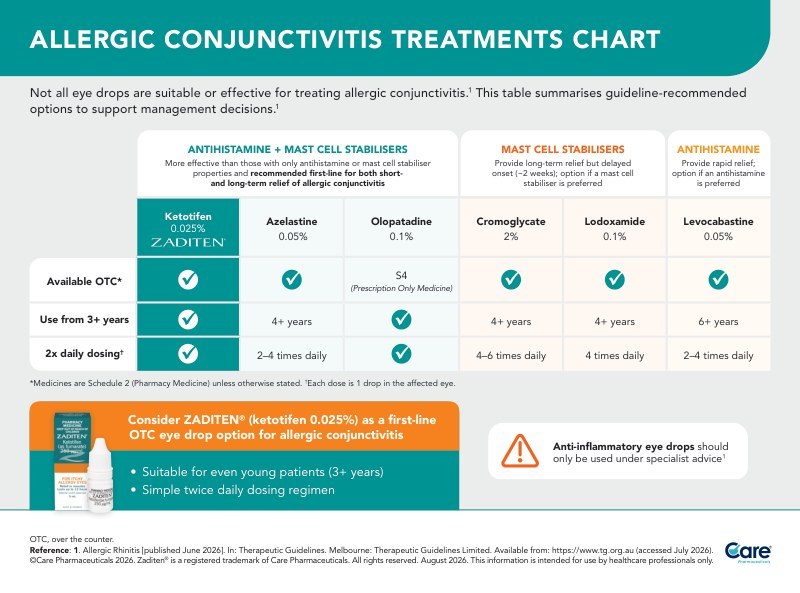
Allergic Conjunctivitis Treatments Chart
Download this summary of guideline-recommended eyedrop options, including information on Zaditen®
To download this resource, please login or register.
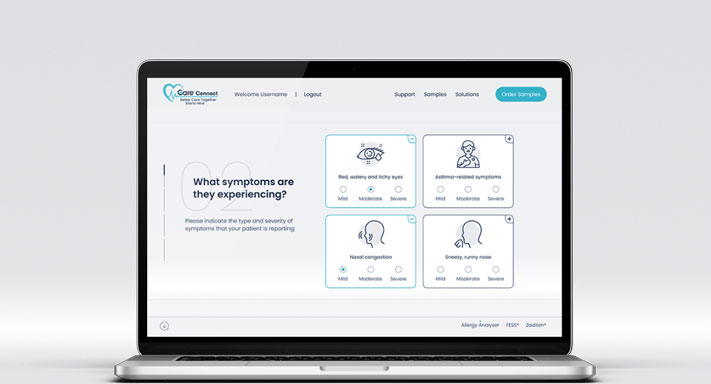
Allergy Analyser
Access the Allergy Analyser to create a personalised allergy treatment recommendation for your patients
Please login or register to gain free access to Care Connect.
Please login or register to gain free access to Care Connect.
References:
- Frings A, et al. Dtsch Arztebl Int. 2017;114(17):302-312.
- Conjunctivitis [published 2025 Mar]. In: Therapeutic Guidelines. Melbourne: Therapeutic Guidelines Limited; accessed July 2025.
- Gin C, et al. Aust J Gen Pract. 2024;53(11):847-852.
- Allergic rhinitis [published 2020 Dec; amended 2025 Mar]. In: Therapeutic Guidelines. Melbourne: Therapeutic Guidelines Limited; accessed July 2025.
- Leonardi A, et al. Curr Allergy Asthma Rep. 2024;24(7):347-360.
- Zaditen Australian Product Information and New Zealand Data Sheet.
©Care Pharmaceuticals 2025. Zaditen® is a registered trademark of Care Pharmaceuticals. All rights reserved. August 2025.
This information is intended for use by healthcare professionals only