Allergy
Nasal Health
27.09.2023
Australia’s perpetual allergy problem is only getting worse
Almost 20% of the Australian population is living with an allergic disease, including allergic rhinitis, and it is predicted this will increase by 70% by 2050. 1

The effects of climate change are expected to contribute to this increase. Higher temperatures and more carbon dioxide in the atmosphere may significantly boost levels of allergens in the air such as grass pollen. 2 At the same time, pollen levels are changing, starting earlier, and going on for longer, 2 presenting a risk for allergic rhinitis sufferers.
Allergies are a 365 day-a-year problem in Australia
The timing of exposure of grass pollens across Australia means that there are peak grass pollen levels in at least one capital city every month of the year. 3
Table 1. Poaceae (grass) pollen calendar for aerobically significant pollen taxa by urban area in Australia. *3

*Adelaide not included in the study
Nasal congestion is a hallmark of allergic rhinitis, which is also linked to asthma 4-6
Allergic rhinitis causes mucosal inflammation, which disrupts mucociliary clearance, contributing to nasal congestion. 4,5 Accordingly, the target of medical treatment is to restore and assist mucociliary clearance. 4
Allergic rhinitis also coexists in up to 80% of patients with asthma. 6 There is increasing evidence to suggest that better management of rhinitis may reduce the morbidity associated with asthma. 7 Current guidelines recommend that people with asthma are assessed for rhinitis, and vice versa, so that their symptoms can be optimally managed. 8
Nasal saline irrigation (NSI) is an effective and safe way to improve mucociliary clearance 9
NSI is an effective and safe way to improve mucociliary clearance 9
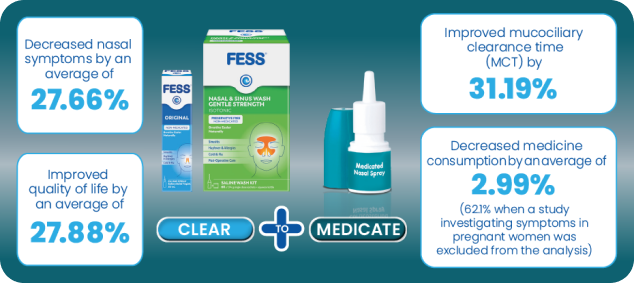
Recommend pre-treatment with FESS® to help improve the effectiveness of medicated sprays
A systematic review and meta-analysis reported that, when used as an adjunctive treatment in allergic rhinitis, pre-treatment with nasal saline irrigation (either spray or rinse): 10
According to the National Asthma Council Australia, nasal saline irrigation with FESS® products may be a better choice for people with medically diagnosed asthma or allergies.
For more information on the main intranasal treatment options available for allergic rhinitis, download the National Asthma Council’s Allergic Rhinitis Treatment Chart.
NSI in adults should be performed 15 minutes prior to administration of the medicated spray and can be used again an hour after administration of the medicated spray. 11
The blue butterfly means that the pictured FESS products have been assessed by the National Asthma Council Australia’s independent and voluntary panel of experts and may be a better choice for people with medically diagnosed asthma or allergies.
References 1. Victorian Department of Health. Allergies. Available at: https://www.health.vic.gov.au/chief-health-officer/allergies 2. Public Health Research and Practice. Australia unprepared for climate change impact on allergies. Available at: https://www.phrp.com.au/media/media-releases/australia-unprepared-climate-change-impact-allergies/ 3. Haberle SG, et al. PloS One. 2014;9(5):e97925. 4. Morcom S, et al. Aust Fam Physician. 2016;45(6):374–377. 5. Naclerio RM, et al. Int J Gen Med. 2010;3:47–57. 6. Egan M, Bunyavanich S. Asthma Res Pract. 2015;1:8. 7. Scadding GK. Archives of Disease in Childhood. 2015;100:576-582. 8. Scadding G, Walker S. Prim Care Respir J. 2012;21(2):222-228. 9. Ural A, et al. J Laryngol Otol. 2009;123(5):517–21. 10. Hermelingmeier KE, et al. Am J Rhinol Allergy. 2012;26:e119–125. 11. National Asthma Council Australia, 2022. Australian Asthma Handbook v2.2. Available at: https://www.asthmahandbook.org.au/clinical-issues/allergies/allergic-rhinitis/adults-adolescents
FESS® is a registered trademark of Care Pharmaceuticals. All rights reserved. © Care Pharmaceuticals 2022. This information is intended for use by healthcare professionals only.