Allergy Health
27.08.2025
Keeping up with clinical trials:
ARISE for allergic rhinitis

Allergic rhinitis (AR) affects more than six million Australians,1 with that number likely to keep climbing as environmental change drives longer, more intense pollen seasons2-6 – and despite the availability of effective treatments, almost half suffer through uncontrolled symptoms, with poor patient knowledge and improper use being heavily implicated.7,8
As part of its Respiratory Allergy stream, the National Allergy Centre of Excellence (NACE) is tackling this challenge head-on through the ARISE trial: Allergic Rhinitis Improvement through Strategic Education.9 Launched in March 2025, learn how this study is exploring a new approach to allergic rhinitis care for the benefit of young Australians.
The impact of AR on young people
AR often begins early, with most individuals developing symptoms before age 20.10 In the 2022 National Health Survey, around 13% of children aged 0–14 years and 27% of those aged 15–24 years were affected.1
While sometimes dismissed as a trivial condition, poorly controlled AR can have far-reaching consequences for adolescents, including impaired sleep quality, reduced school attendance, lower academic performance, and decreased emotional wellbeing.10 Given that adolescence and young adulthood are critical periods for physical, emotional, and academic development, this is an opportune time to reinforce optimal disease management—especially as AR is often sub-optimally managed.7,8
Unpacking the ARISE trial
Researchers at the NACE state that a lack of patient education leads to improper use and misconceptions about intranasal medications, compromising adherence and resulting in poor AR symptom control.9,11 The ARISE trial will therefore provide young Australians living with AR with a specifically designed education package alongside their daily intranasal corticosteroid spray, with an aim to evaluate the impact and effectiveness of education in reducing symptoms and improving quality of life.9,11
Study design9,11
- Participants – Australians aged 14 to 29 years who have been clinician-diagnosed with moderate to severe allergic rhinitis, have a positive skin prick test to at least one environmental allergen, and are recommended a combination intranasal corticosteroid/antihistamine spray for treatment as part of an ASCIA Allergic Rhinitis Treatment Plan. Participants will be randomised 1:1 into two treatment arms.
- Intervention – Standard education during doctor’s appointments plus an Enhanced Education Package (EEP), combined with daily use of an intranasal corticosteroid spray. The EEP is designed to improve young people’s knowledge and adherence to the correct use of their nasal spray, and includes weekly SMS and email reminders on dosing frequency, correct technique, pollen count updates, and links to education resources.
- Comparator – Standard education during doctor’s appointments only, alongside daily intranasal corticosteroid spray use.
- Primary outcomes – Differences in nasal symptom scores between the two study arms at 3 months post-randomisation.
- Secondary outcomes – Differences in nasal symptom scores at 9 months; ocular symptom scores; quality of life scores; participant knowledge, attitude and practice on nasal steroid use; scores for nasal spray application technique; and engagement with educational resources.
Recruitment is currently underway at 17 general practices and allergy clinics across every state and territory in Australia, with completion of the study expected in May 2026.9,11
Current recommendations for medical management of AR
Guidelines advise that treatment of allergic rhinitis should be tailored to symptom severity and frequency, with non-sedating oral or intranasal antihistamines recommended first-line for mild intermittent symptoms, and the addition of intranasal corticosteroids recommended for persistent or moderate-to-severe symptoms.12,13 Importantly, it is recommended that a treatment is trialled for at least 4 weeks before assessing efficacy, and adherence and spray technique checked before escalating therapy.12,13
Nasal saline is also recommended as a well-tolerated and effective adjunct treatment to pharmacotherapy across the spectrum of allergic rhinitis presentations.12 Specifically, pretreatment with nasal saline may help improve effectiveness of medicated nasal sprays in adults,14 with saline recommended to be used 10 minutes before administration of a medicated nasal spray to clear the nasal passages.13 A systematic review and meta-analysis of randomised controlled trials found adjunct use of nasal saline in both adults and children resulted in 31.2% faster mucociliary clearance, 27.7% improvement in nasal symptom scores and 27.9% improvement in quality of life.*15
For both medicated sprays and nasal saline sprays, correct technique is essential for effective and safe use.13 Patients need to be advised to aim outwards towards the outer wall of the nose and the ear, so that the spray can reach the highly vascularised turbinate region of the nasal cavity.12,13,16 Instructions for correct administration are incorporated in the ASCIA Treatment Plan for Allergic Rhinitis, and patient videos are also available to demonstrate correct use of nasal saline sprays and washes.
Will things only get worse? Why AR prevalence is rising
Australia has one of the highest prevalences of AR in the world, as well as some of the highest rates of allergic sensitisation to common aeroallergens.2,3 This makes Australians vulnerable to the adverse impacts of climate change on allergens and allergic disease.2
Climate strongly influences airborne pollen in Australia, with climate change expected to increase pollen production, allergenicity and season duration, elevating the risk of prolonged and unpredictable exposure.2-6 Indeed, incidence of respiratory diseases in Australia has increased over the last decades due to a higher prevalence of airborne allergens.3 An increase in weather extremes can also heighten the risk of asthma exacerbations, as was seen in the world’s worst case of epidemic thunderstorm asthma that occurred in Melbourne in November 2016.2,3
With these evolving environmental challenges, trials like ARISE are more important than ever to accelerate allergy research and support patients with evidence-based allergy care.
Treatment Chart
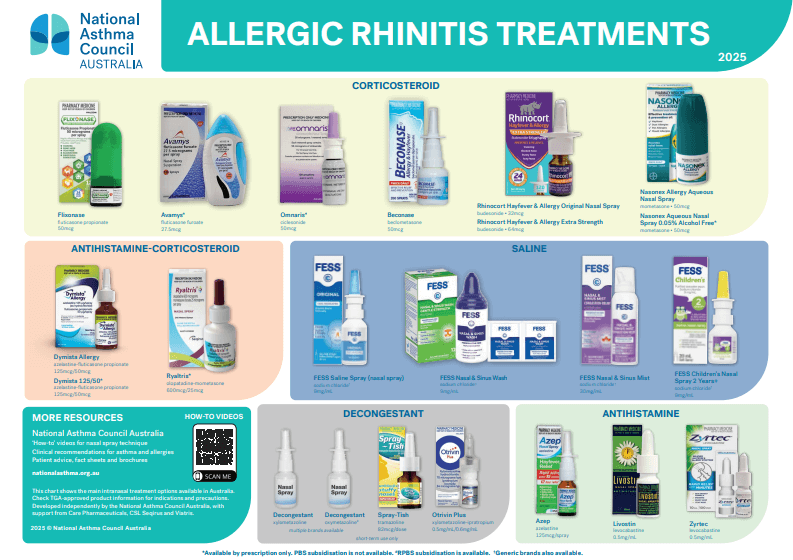
Download the National Asthma Council Allergic Rhinitis Treatment Chart.
How-to videos
View helpful FESS How-to videos for patients.
To download this resource, please login or register.
ASCIA, Australasian Society of Clinical Immunology and Allergy.
*Systematic review of 10 randomised controlled trials assessing use of nasal saline irrigation as an adjunct to standard care for up to 7 weeks in >400 adults and children with allergic rhinitis.15
References:
- Australian Bureau of Statistics. National Health Survey. Released 15 Dec 2023. Available from: https://www.abs.gov.au/statistics/health/health-conditions-and-risks/national-health-survey/latest-release#data-downloads (accessed August 2025).
- Beggs PJ. Public Health Res Pract 2018;28(4):2841828.
- Hughes KM, et al. Ther Adv Respir Dis 2022;16:17534666221099733
- Ziello C, et al. PLoS One 2012;7(4):e34076.
- Ziska L, et al. Proc Natl Acad Sci U S A 2011;108(1):4248–51.
- Kelish AE, et al. BMC Plant Biol 2014;14:176.
- Katelaris CH, et al. Am J Rhinol Allergy 2013;27(6):506–509.
- Rollema C, et al. J Asthma Allergy 2019;12:91–94.
- National Allergy Centre of Excellence. Respiratory allergy: The ARISE Trial. Available from: https://www.nace.org.au/research/respiratory-allergy/ (accessed August 2025).
- Blaiss MS, et al. Ann Allergy Asthma Immunol 2018;121(1):43–52.
- Allergic Rhinitis Improvement Through Strategic Education: The ARISE Trial (ARISE). ClinicalTrials.gov identifier: NCT06686446. Available from: https://clinicaltrials.gov/study/NCT06686446 (accessed August 2025).
- Australian Society of Clinical Immunology and Allergy (ASCIA). Allergic Rhinitis Clinical Update 2024. Available from: https://www.allergy.org.au/hp/papers/allergic-rhinitis-clinical-update (accessed August 2025).
- Allergic rhinitis [published 2020 Dec; amended 2025 Mar]. In: Therapeutic Guidelines. Melbourne: Therapeutic Guidelines Limited; accessed July 2025. https://www.tg.org.au.
- Wang Y, et al. Allergol Immunopathol (Madr) 2020;48(4):360–367.
- Hermelingmeier KE, et al. Am J Rhinol Allergy 2012;26(5):e119–e125.
- Sawant N, Donovan MD. Pharm Res 2018;35(5):108.
©Care Pharmaceuticals 2025. FESS® is a registered trademark of Care Pharmaceuticals. All rights reserved. August 2025. This information is intended for use by healthcare professionals only.