
Nasal Health
22.05.2022
Give parents the tools to help relieve kids’ winter illness symptoms
The arrival of winter is often associated with seasonal respiratory infection. This is especially true in children who can experience common winter illnesses, such as the common cold and flu, as many as 8 to 10 times a year! 1,2 But why are respiratory infections more common in winter and why are children more susceptible?

To address these questions, first, we have to understand why we are generally more susceptible to illness during winter. The most common cause of respiratory infection are viruses which show seasonally increased abundance during winter in temperate regions. 3,4 It has been hypothesised that seasonal environmental and behavioural changes are to blame for this phenomenon. 4–6 Cold and dry weather is associated with immune impairment and the drying of the nasal passage which collectively increase virus viability and transmission. 5,6 This, coupled with changing social behaviours such as meeting indoors and closer social contact, leads to optimal conditions for the spread of respiratory infections. 5,6
The increased abundance of respiratory viruses within the community during winter has a significant impact on children due to their relatively naïve immune system compared to adults. 7,8 Our immune system develops throughout life by building memory to infections that we encounter. 7,8 This immune memory allows us to respond to subsequent exposures more quickly and effectively which may reduce or eliminate the symptoms of the infection. As children have not been exposed to as many infectious agents as adults in their lifetime, children have not developed immunity to many of the hundreds of viruses associated with common winter illnesses. As such, kids are more likely to feel the effects of infections they encounter while they develop their immune memories.
Whatever the cause, common winter illnesses are a real challenge for children. Symptoms such as congestion and coughs can have a significant impact on patient quality of life. Apart from being uncomfortable, these symptoms can impact both sleep quality and quantity. 9–11 This has flow-on effects on energy levels, productivity, mood, and duration of illness. Therefore, it is important that parents are empowered to help alleviate these symptoms to relieve the burden of winter illness from their children.
Care offers a range of products specially designed for little patients, to help parents provide relief for common winter illness symptoms this winter
Recommend FESS ® Little Noses to help remove excess mucus, relieving nasal congestion 12,13
Nasal saline irrigation products such as FESS ® provide a non-prescription, patient-controlled therapy for the relief of nasal congestion. 12,13 Saline irrigation may be effective in reducing symptom duration and improving health status in children suffering common cold and flu. 14
Care offers a range of FESS ® products that are specially designed for babies’ and kids’ noses. Available in spray and drop bottles, these gentle saline products work to loosen and thin nasal mucus to relieve nasal congestion. FESS® Little Noses products are also available with or without aspirators to gently suction and remove loosened mucus. 15,16
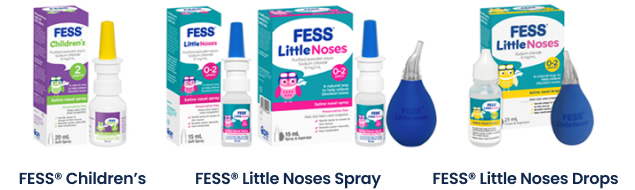
The blue butterfly means that the pictured FESS products have been assessed by the National Asthma Council Australia’s independent and voluntary panel of experts and may be a better choice for people with medically diagnosed asthma or allergies.
Recommend Little Coughs ® to help relieve cough associated with mild bronchitis in children as young as 6 months 17-28
Little Coughs ® is an oral cough syrup containing Ivy Leaf extract. Ivy Leaf has been used as a traditional medicine to soothe and relieve coughs associated with mild bronchitis and chesty congestion. Little Coughs ® offers convenient 2.5 mL once daily dosing for kids between the age of 6 months and 2 years and is available in two flavours, original and raspberry, so parents can tackle their kids’ chesty cough this winter. 28

References 1. Colds in children. Pediatric Child Health. 2005 Oct;10(8):493-5. 2. Eccles R. Lancet Infect Dis. 2005 Nov;5(11):718–25. 3. Lam TT, et al. J Infect. (2019) 79:373–82. 4. Ganslmeier M, et al. Scientific reports. 2021 Nov 11;11(1):22027. 5. Audi A, et al. Frontiers in Public Health. 2020 Sep 15;8:567184. 6. Tan J, et al An initial investigation of the association between the SARS outbreak and weather: with the view of the environmental temperature and its variation. Journal of Epidemiology & Community Health. 2005 Mar 1;59(3):186-92. 7. Kloc M, et al Clinical Immunology. 2020 Aug 1;217:108510. 8. Delves PJ, Roitt IM. N Engl J Med. 2000 Jul 6;343(1):37-49. 9. Stewart M, et al. Int J Gen Med. 2010 Apr 8;3:37-45. 10. Stewart M, et al. International journal of general medicine. 2010 Apr 8:37-45. 11. Stull DE, et al. Current medical research and opinion. 2007 Apr 1;23(4):811-9. 12. Wang YH, et al. J Microbiol Immunol Infect. 2014;47(1):63-9. 13. Papsin B, McTavish A. Can Fam Physician. 2003 Feb 1;49(2):168-73. 14. Fashner J, et al. Am Fam Physician. 2012 Jul 15;86(2):153-9. 15. FESS ® Children’s Product Label. 16. FESS ® Little Noses Spray Product Label. 17. Schaefer A, et al. ERJ Open Res. 2019 Dec 8;5(4):00019-2019. 18. Khan MF, et al Pak J Pharm Sci. 2018 Nov;31(6 (Supplementary):2617-2622. 19. Ali Z, et al. Pak J Pharm Sci. 2017 Mar;30(2(Suppl.)):591-596. 20. Wahid NWB, Shermetaro. 2022 Sep 5. In: StatPearls [Internet]. Treasure Island (FL): StatPearls Publishing; 2023 Jan. 21. Safina AI. Zeitschrift für Phytotherapie. 2014 Dec;35(06):262-7. 22. Cwientzek U, et al. Phytomedicine. 2011 Oct 15;18(13):1105-9. 23. Khan M, et al. Pak J Pharm Sci. 2019Jan;32(1(Supplementary)):339-343. 24. Schönknecht K, et al. Wiad Lek. 2017;70(1):1026-1033. 25. Lang C, et al. Planta Med. 2015 Aug;81(12-13):968-74. 26. Schmidt M, et al. Phytother Res. 2012 Dec;26(12):1942-7. 27. Stauss-Grabo M, et al. Phytomedicine. 2011 Apr 15;18(6):433-6. 28. Little Coughs ® Product Label..
This information is intended for use by healthcare professionals only.
FESS ® and Little ® are registered trademarks of Care Pharmaceuticals.
All rights reserved. © Care Pharmaceuticals 2023.