Womens Health
12.04.2022
Tips to CARE for your pregnant patients
Achieving optimal maternal health during pregnancy is recognised as an essential component to the outcome of the pregnancy and may have a potentially lifelong impact on the child’s wellbeing. 1
During pregnancy, many physiological changes occur that can cause significant discomfort for some women. 2 Health professionals play an important role in helping pregnant women to navigate health challenges that present during this time, which may include dehydration 3 and nasal congestion. 4

Dehydration
Fluid requirements increase during pregnancy and breastfeeding to prevent dehydration
A pregnant woman has slightly increased fluid requirements compared to a non-pregnant woman because of expanding extracellular fluid space, the needs of the foetus and the amniotic fluid. 5
During breastfeeding, these requirements increase again due to fluid lost in breast milk. 5
Recommended adequate intake of fluid: 5
*For women 19 years of age and over.
Some pregnant and breastfeeding women may experience dehydration due to:
- Nausea and vomiting during pregnancy (NVP) – Affects about 80 per cent of pregnant women. 6 In severe cases, it may cause dehydration due to fluid and electrolyte loss and a decreased intake of food and fluids during this time. 7
- Fluid loss during labour – Depending on the length of labour, a woman can lose considerable amounts of fluid and electrolytes through physical exertion during birth. 8
- Not consuming enough fluids – A busy schedule and adjusting to a new routine can mean breastfeeding women in particular, forget to rehydrate.
Tip 1: An oral rehydration solution (ORS) can effectively help treat the symptoms of dehydration during pregnancy and breastfeeding
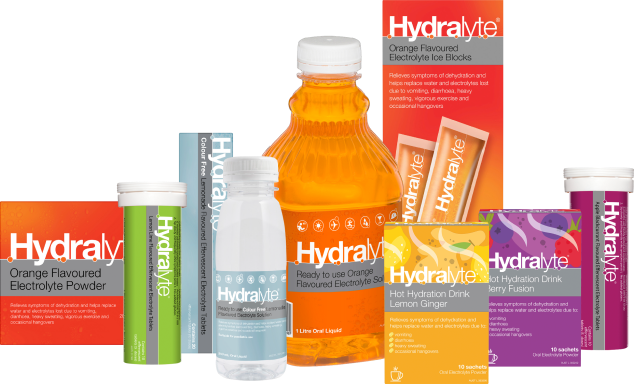
Using an ORS such as Hydralyte® is a simple, proven intervention that is suitable for use during pregnancy, labour and breastfeeding, and can help rehydrate those with mild or moderate dehydration symptoms faster than water alone. 9,10
*As the Hydralyte Sports® and Hydralyte® Plus ranges contain electrolytes plus additional ingredients, please read the full ingredient list before recommending these to your pregnant patients.
Nasal Congestion
2 in 3 women report nasal stuffiness at some point during their pregnancy 11
Pregnancy-related hormonal and vascular changes 12,13 can aggravate pre-existing nasal conditions or predispose some women to develop new nasal disorders. 14
Common causes of nasal congestion during pregnancy include: 14

Allergic rhinitis
About 20-40% of women of reproductive age report experiencing rhinitis. 15

Sinusitis
Infectious sinusitis during pregnancy is reported to be 6 times the level seen in non-pregnant women. 16

Upper respiratory infections
Such as the common cold and influenza. 14

Upper respiratory infections
Such as the common cold and influenza. 14
Tip 2: Nasal saline irrigation is a natural way to relieve nasal congestion during pregnancy
Nasal saline irrigation products such as FESS® (excludes FESS® Nasal Defence and FESS® Eucalyptus):
- provide a simple, non-medicated, patient-controlled therapy for nasal congestion that is suitable during pregnancy 18-20
- are suggested as an effective option in pregnant women for symptom relief in conditions such as mild to moderate allergic rhinitis, 21 rhinoconjuctivitis, 16 chronic rhinosinusitis, 22 and post-nasal drip in pregnancy. 16
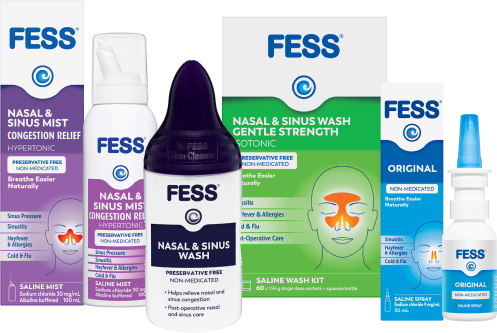
The blue butterfly means that the pictured FESS products have been assessed by the National Asthma Council Australia’s independent and voluntary panel of experts and may be a better choice for people with medically diagnosed asthma or allergies.
References 1. 1. Frayne J, Hauck Y. Aust Fam Physician. 2017;46(1):20-25. 2. Kazemi F, et al. J Clin Diagn Res. 2017;11(4):QC06-QC10. 3. Zhang N, et al. BMC Pregnancy Childbirth. 2020;20(1):82. 4. Bende M, Gredmark T. Laryngoscope. 1999;109(7 Pt 1):1108-10. 5. Nutrient Reference Values for Australia and New Zealand. Water. Available at: https://www.eatforhealth.gov.au/nutrient-reference-values/nutrients/water. [Accessed 21 December 2022]. 6. National Library of Medicine. Nausea and Vomiting in Pregnancy (NVP). 2022. Available at: https://www.ncbi.nlm.nih.gov/books/NBK582541/. [Accessed 12 December 2022]. 7. NSW Health. Hyperemesis gravidarum. 2022. Available at: https://www.health.nsw.gov.au/kidsfamilies/MCFhealth/Pages/hyperemesis-gravidarum.aspx [Accessed: 12 December 2022]. 8. Dawood F, et al. Cochrane Database Syst Rev. 2013;(6):CD007715. 9. World Health Organization (WHO). Oral rehydration salts. Production of the new ORS. 2006. Available at: https://www.who.int/maternal_child_adolescent/documents/fch_cah_06_1/en/ [Accessed December 2022]. 10. Wright EM, et al. Physiol Rev. 2011;91(2):733-94. 11. Bende M, Gredmark T. Laryngoscope. 1999;109(7 Pt 1):1108-10. 12. Indirani B, et al. J Laryngol Otol. 2013;127(9):876-81. 13. Dykewicz MS, et al. J Allergy Clin Immunol. 2020;146(4):721-67. 14. Wei W, et al. Cochrane Database Syst Rev. 2015;5:CD011653. 15. Namazy JA, Schatz M. Curr Allergy Asthma Rep. 2014;14:458. 16. Incaudo GA. Clin Rev Allergy Immunol. 2004;27(2):159-77. 17. Ellegård EK. Clin Rev Allergy Immunol. 2004;26(3):149-59. 18. Casale M, et al. Int J Immunopathol Pharmacol. 2018;32:2058738418802676. 19. Wang YH, et al. J Microbiol Immunol Infect. 2014;47(1):63-9. 20. Garavello W, et al. Int Arch Allergy Immunol. 2010;151(2):137-41. 21. Rabago D, Zgierska A. Am Fam Physician. 2009;80(10):1117-9. 22. Lal D, et al Rhinology. 2016;54(2):99-104.
FESS® and Hydralyte® are registered trademarks of Care Pharmaceuticals.
All rights reserved. © Care Pharmaceuticals 2023.
This information is intended for use by healthcare professionals only.