
Rectal Health
01.12.2021
How you can best ass-ist your patients with anal fissures
All jokes aside, anal fissures can cause significant pain for many patients, both young and old.
It has been suggested that up to one in five individuals develop a fissure in their lifetime. However, the reluctance of people to discuss the issue with their healthcare provider means the incidence is likely higher. 1

What causes anal fissures?
Primary anal fissures are typically benign and are most likely related to local trauma such as hard stools, prolonged diarrhoea, pregnancy and childbirth, injury or penetration. 2
Secondary fissures usually indicate a more serious underlying pathology such as inflammatory bowel disease, sexually transmitted disease, tuberculosis, anal cancer or HIV. 2 They may also be due to previous anal surgical procedures. 2
Once a fissure develops, pain and impaired healing (compromised by bowel movements) leads to persistent spasm of the internal anal sphincter (IAS). 3 The increased IAS pressure causes the tear to worsen and constricts blood flow, further delaying wound healing. 3
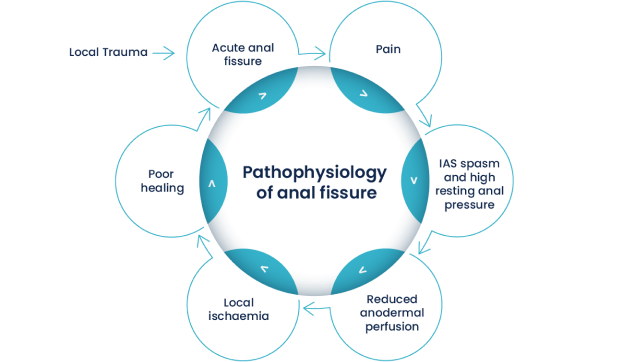
Adapted from Schlichtemeier S and Engel A, 2016. 2
In adults, acute anal fissures (those lasting less than 6 weeks) are thought to precede chronic anal fissures. 4 Evidence suggests that aggressive medical treatment in combination with ongoing conservative care can prevent the fissure from becoming chronic. 4
First-line treatment of anal fissures
When treating anal fissures, the goal is to break the cycle of anal sphincter spasm using a step-wise approach. 2
Initial medical treatment may include frequent sitz baths, stool softeners, a high fibre diet and adequate fluid intake. 5 If these conservative methods fail, other options such as topical glyceryl trinitrate – the active ingredient in Rectogesic® Ointment – can be very effective.
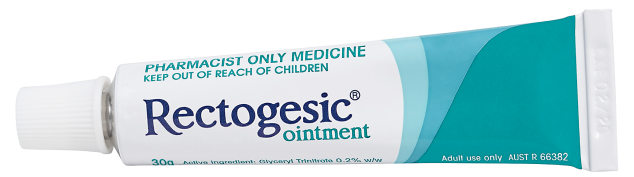
Glyceryl trinitrate reduces IAS spasm via the production of nitric oxide, which relaxes anal smooth muscle. 6 It also increases blood flow, relieves pain, and promotes wound healing. 7,8
Topical glyceryl trinitrate has been shown to help heal up to 70% of chronic anal fissures within 2-8 weeks. 6,9
How to apply Rectogesic®
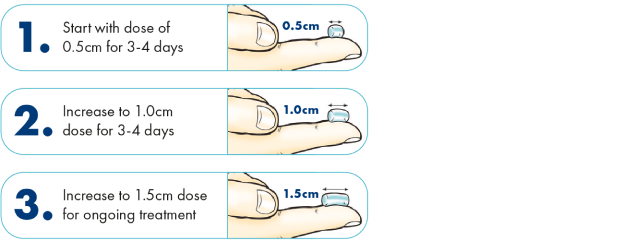
Patients should not apply more than the recommended dose of 1.5 cm of Rectogesic® Ointment. Headaches may occur but are usually mild and typically happen only after the first few applications. The use of a disposable glove or wrapping the finger in Gladwrap may help reduce absorption. If headaches occur with the recommended dose, then begin with a lower dose as outlined below:
 Explore the 3D Rectal Model
 References 1. Stewart, D.B. (2021). Patient education: Anal fissure (Beyond the Basics). UpToDate. Available at: https://www.uptodate.com/contents/anal-fissure-beyond-the-basics (Accessed: October 31, 2022). 2. Schlichtemeier S, Engel A. Aust Prescr. 2016;39:14–7. 3. Fahadullah M, Peirce C. In: Proctological Diseases in surgical practice. London, United Kingdom: IntechOpen; 2018. p. 81–103. 4. Nelson R. Dis Colon Rectum. 2004;47(4):422-31. 5. Jahnny J, Ashurst JV. (Updated 2021). Anal Fissures. National Library of Medicine. Available at https://www.ncbi.nlm.nih.gov/books/NBK526063/ (Accessed October 31, 2022) 6. Lund JN, Scholefield JH. Lancet. 1997;349(9044):11–4. 7. Tjandra JJ, et al. Colorectal Dis. 2007;9(5):457–63. 8. Kennedy ML, et al. Dis Colon Rectum. 1999;42(8):1000-6. 9. Scholefield JH, et al. Gut. 2003;52(2):264–9.
Rectogesic® is a registered trademark of Care Pharmaceuticals. All rights reserved. © Care Pharmaceuticals 2022. This information is intended for use by healthcare professionals only.