Case study
27.10.26

Travelling with diabetes: A 3-step check before take‑off
- 1Meet Jess
- 2Identify the risks
- 3Decide the discussion
- 4Prepare the plan
Staying healthy when travelling is important for everyone, but for your patients with diabetes, travelling can come with extra considerations and risks.
Put your pre-travel health check skills to the test with this mini case study.
Meet your patient

- Jess, 54 years old, female
- Well-controlled type 2 diabetes
- Medications: metformin, empagliflozin
Jess is booked in for a pre-travel consultation to discuss travel vaccines.
Identify the risks: Click on each clue to discover more details about Jess’s travel plans to help tailor your advice.
Now that you’ve learned more about Jess’s travel plans, which of the following factors may affect her health while she is travelling?
Decide the discussion: After discussing travel vaccines with Jess, there is limited time left in today’s consultation. You’ll need to choose which of the following points you will prioritise for further discussion.
Move each discussion point into the most appropriate column. Each column can hold a maximum of three cards – choose carefully!
Drag each card into a column, or tap a card and then tap a column.
Prepare the plan: Jess confirms that she doesn’t have a sick day plan to take with her to Vietnam, so it’s time to create one together.
For each of the sick day plan components below, select the correct guideline-based advice to give Jess if she were to become unwell or dehydrated during her trip.
Checking glucose2,3
Jess should check her blood glucose levels more regularly, generally…
Medication management2,3
If Jess experiences vomiting or diarrhoea, she should…
Adequate hydration2,3
To stay hydrated, Jess should aim to drink…
Appropriate fluids2,3
If Jess’ blood glucose levels are above 10 mmol/L, she should consume…
Oral rehydration solutions (ORS)2,3
Advise Jess that ORS are suitable for hydration and…
Support travel health in your patients with diabetes
For patients with diabetes and other chronic conditions, pre-travel health checks are a valuable opportunity to provide important travel health and safety education that these patients may not have previously considered.
Keep these key questions in mind for your next pre-travel consultation:
- What potential risks could your patient be exposed to? Consider the location and climate, and your patient’s age, comorbidities, and medications.
- Is your patient’s treatment travel-ready? Review their access to medications and medical supplies, and whether any management adjustments are required.
- Does your patient know what to do if illness develops? Create an individualised sick day plan and ensure they understand appropriate strategies for managing dehydration.
- What hydration strategy do you recommend for your patient? Consider that oral rehydration solutions, such as Hydralyte, are formulated to rehydrate faster than water alone4-7 and may be considered as part of diabetes sick day management.2,3
- When and where should your patient seek help? Provide clear and practical instructions to follow if they do require medical attention.
Related resources

Diabetes Sick Day Care Plan
A simple 2-page template to personalise for your patients
Traveller’s diarrhoea: quick management guide
Read the latest on prevention and management strategies

KOL Clinical Bites
Bite-sized videos offering practical sick day management advice, featuring CDE Deb Hawthorne
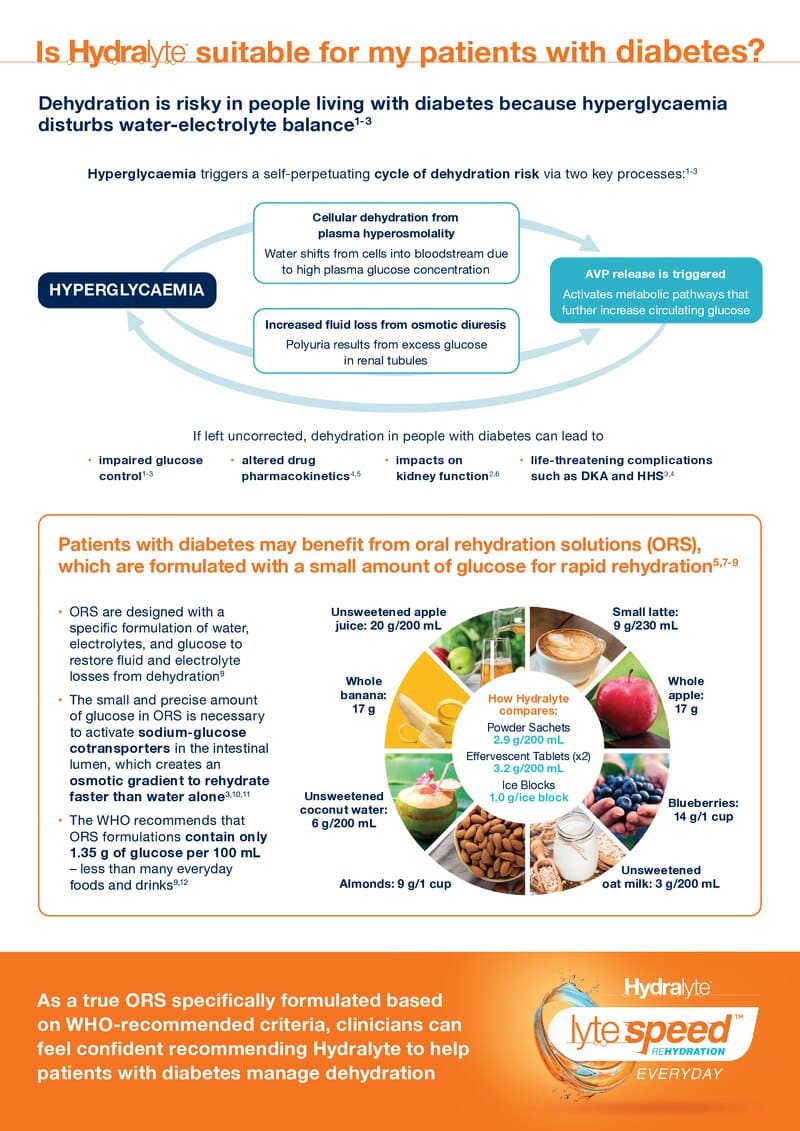
Using Oral Rehydration Solutions in diabetes
A helpful factsheet summarising key considerations and guideline recommendations
Order Hydralyte samples
Delivered directly to your practice, free of charge
Perhaps there’s another factor you could consider?
Great choice!
The heat and humidity and large amounts of walking can increase Jess’ risk for dehydration, which may already be elevated following reduced fluid intake. She may also be putting herself at risk for food- or water-borne infections that could result in vomiting and diarrhoea, further exacerbating any dehydration. Importantly, dehydration and acute illness compromise diabetes control, and her medications (particularly the SGLT2 inhibitor) can increase the risk of developing diabetic ketoacidosis during illness.1
Nicely done!
Jess’ immediate travel risks are dehydration and acute illness, particularly if she develops vomiting or diarrhoea while on her regular medicines. Sick day planning, medication readiness and practical hydration strategies should therefore be prioritised, as they are key to reducing her risk of acute harm while travelling.2
If time permits, discussion on food and water safety, mosquito-bite prevention and travel insurance/access to care would also be beneficial based on Jess’ itinerary.2 Her routine skin check and mammogram, while important, can be considered a lower priority for today.
Some answers aren’t quite right – which options better match the guidelines?
Perfect!
Providing Jess with a simple, personalised Sick Day Care Plan that provides clear guidance on glucose monitoring, medication management, and appropriate hydration is a practical and highly impactful step to support her health while travelling.
With that, you have successfully navigated your pre-travel health consultation with Jess – congratulations!
References:
- Mohan V, et al. J Assoc Physicians India. 2024;72(6S):16–24.
- Australian Diabetes Educators Association. Clinical guiding principles for sick day management of adults with type 1 diabetes or type 2 diabetes: A guide for health professionals, Version 4.1.0 [updated June 2025]. Available from: https://www.ndss.com.au/wp-content/uploads/clinical-guide-sick-day-mngt.pdf (accessed September 2026).
- National Diabetes Services Scheme. Diabetes Sick Day Action Plan: Type 2 diabetes not using insulin. Version 2.1, February 2025. NDSSQCKG001. Available from: https://www.ndss.com.au/wp-content/uploads/ADEA-Sick-Day-Action-Plan-Type-2-not-using-insulin-fillable.pdf (accessed September 2026).
- World Health Organization (WHO). Oral rehydration salts. Production of the new ORS. 2006. Available from: https://www.who.int/publications/i/item/WHO-FCH-CAH-06.1 (accessed September 2026).
- Mishra AB. Int J Life Sci Biotechnol Pharm Res. 2025;14(7):516–517.
- Jeukendrup AE, et al. Nutr Metabl (Lond). 2009;6:9.
- Wright EM, et al. J Intern Med. 2007;261(1):32–43.
©Care Pharmaceuticals 2026. Hydralyte® is a registered trademark of Care Pharmaceuticals. All rights reserved. October 2026.
This information is intended for use by healthcare professionals only.