
Traveller’s Diarrhoea
24.11.2025
Traveller’s diarrhoea: quick management guide for the holiday season

Australians are travelling abroad again at an all-time high, surpassing even pre-COVID levels1 – and with this also comes the most common travel-related illness: traveller’s diarrhoea, or TD.2-4 Although most cases are mild and self-limiting, the risk of dehydration is high if fluid and electrolyte losses are not adequately replaced.2,5,6
For GPs, pre-travel consultations present an opportunity to provide timely health advice to patients planning to go overseas. Read on for a summary of the latest TD prevention and management strategies, and the key counselling points to cover off with patients.
Pathogen profiles: Differentiating the causes of TD
Traveller’s diarrhoea presents as unformed bowel movements with or without accompanying abdominal cramps, nausea, vomiting, fever, and/or blood in the stools, with the number of stools within a 24-hour period increasing with disease severity.7 Resulting from intestinal infection, transmission occurs through ingestion of contaminated food or water and/or poor hygiene, particularly in regions with inadequate sanitation.5,6
The causative pathogen may be viral, bacterial or protozoal, with incidence depending on destination, season, and other factors.2,7 Bacterial infections account for the vast majority of cases, while protozoal infections are predominantly in longer-term travellers:2,5,7
| Pathogen type | Bacterial | Viral | Protozoal |
|---|---|---|---|
| Typical species/strain5,7 |
|
|
|
| Typical onset5 | Sudden (6–96 hours) | Sudden (6–96 hours) | May be more gradual (1–2 weeks) |
| Typical duration5 | 3–7 days if untreated | 2–3 days | Weeks to months if untreated |
Regardless of the underlying aetiology, rehydration is the first-line intervention across all types of TD.2
Patient profiles: Who is most at risk and where?
Traveller’s diarrhoea can affect an estimated 20–50% of short-term travellers going from developed to developing areas.2,3 The risk varies considerably based on the region, with the highest incidences reported in South and Southeast Asia, Africa, and Central and South America.8
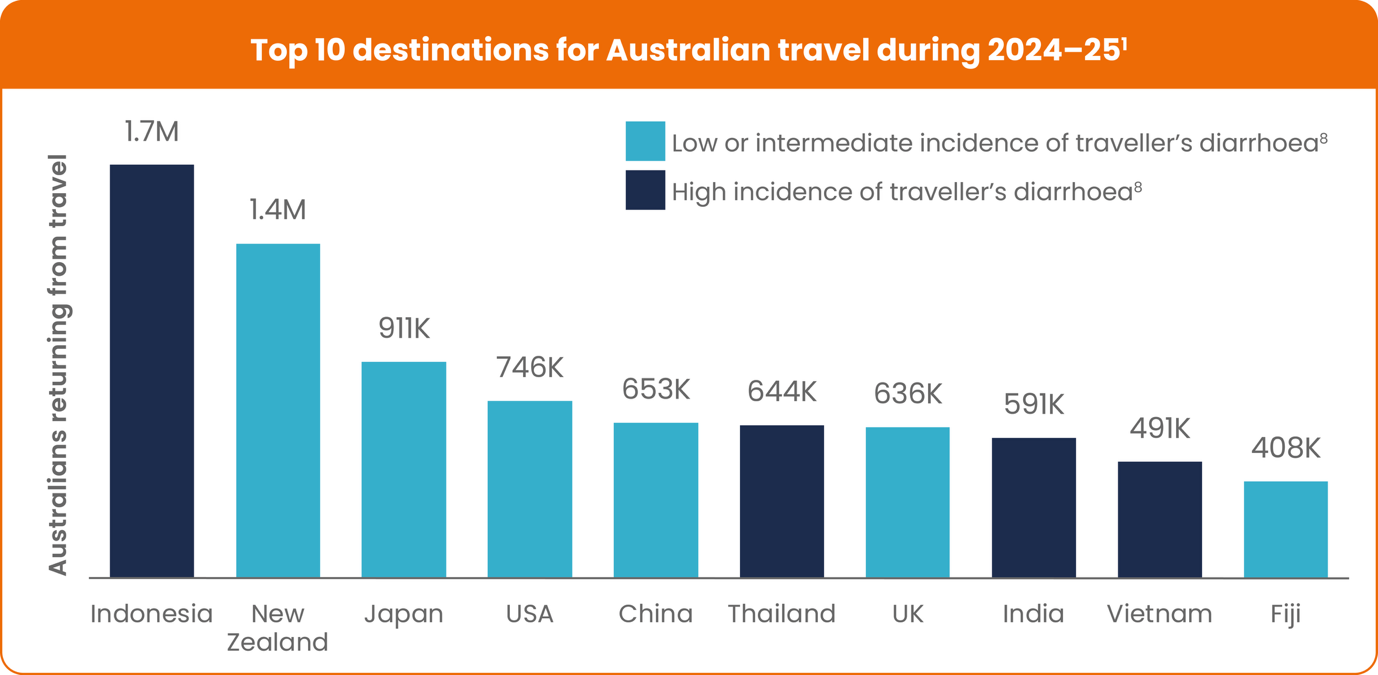
The South and Southeast Asia regions have the most relevance to Australian travellers, according to the 12.3 million short-term overseas returns recorded in 2024–25.1 Indonesia is the top destination for Australians, accounting for 14.2% of all overseas trips.1
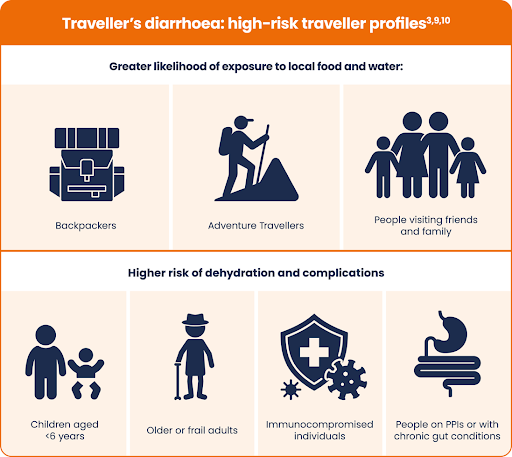
Some traveller types may also be at a higher risk for TD. This can be due to a greater likelihood of exposure to local food/water, biological characteristics, and/or medical history that place them at higher risk of dehydration and complications.3,9,10 Presence of these factors in patients preparing to travel should prompt a thorough discussion about prevention and management strategies.
Advising patients about prevention
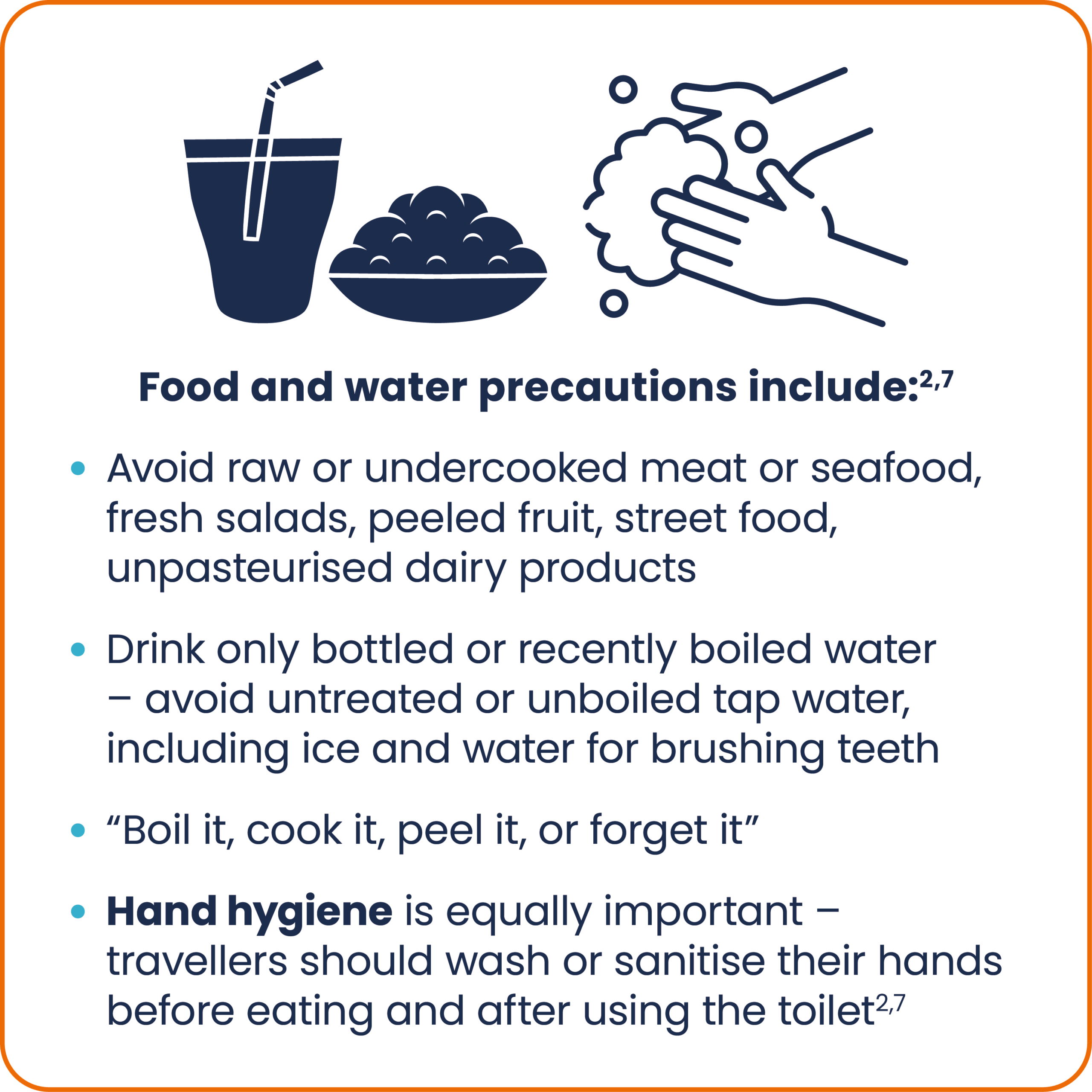
There is no vaccine specifically for traveller’s diarrhoea, and antibiotic prophylaxis should only be considered in individuals at very high risk of infection (e.g., immunocompromised).2,7 Therefore, pre-travel counselling regarding food and water safety remains a key part of reducing risk.2
Advising patients about self-treatment with hydration
Despite best efforts, cases of traveller’s diarrhoea can still occur and strategies for patients to appropriately self-manage while overseas should also be discussed.5,7 While TD is rarely life-threatening, the main complication is dehydration, especially in vulnerable populations.2,5,6
As such, rehydration is first-line therapy in all cases, with oral rehydration solutions (ORS) recommended to treat dehydration.2,5-7 This is because they are formulated with the optimal balance of sodium and glucose to activate sodium-glucose cotransporters (SGLTs) in the intestinal lumen, which facilitates rapid water absorption even when intestinal function is impaired – making them faster and more effective for rehydration than plain water.11,12
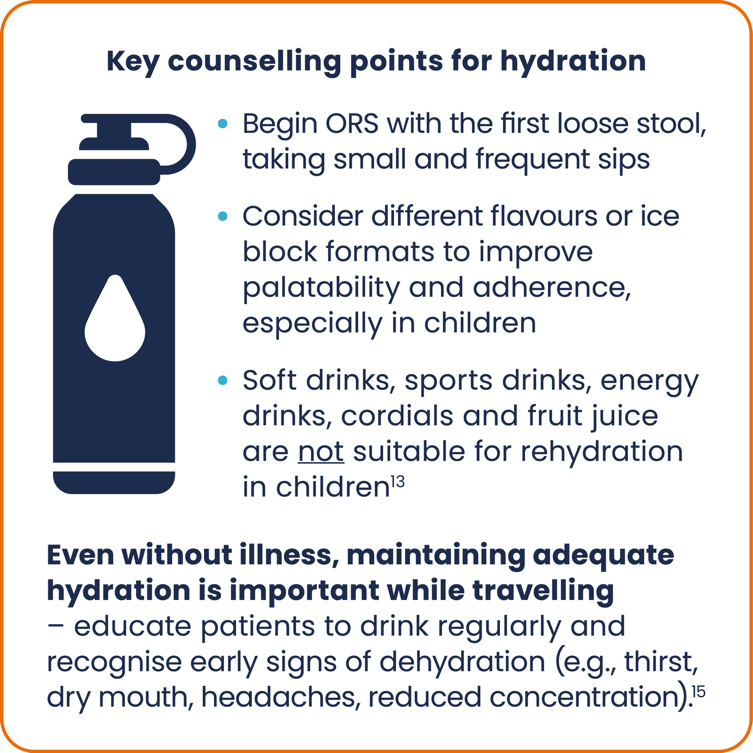
ORS are particularly beneficial for children and other patients with risk factors for dehydration, given these individuals are more prone to fluid loss and electrolyte imbalance.13,14
Patients should be advised to pack ORS sachets or tablets before travelling, so that they don’t have to worry about sourcing appropriate products in a foreign country.7 Sachet and tablet formats are easy to pack and carry, and simple enough to prepare with bottled or boiled water. As best practice, recommend true ORS formulations that meet World Health Organization criteria for effective rehydration, such as Hydralyte.13,14,16
Pharmacotherapy options and when medical intervention is required
Most cases of traveller’s diarrhoea require rehydration alone, but loperamide may be used short-term by adults for symptom control during periods of social inconvenience (e.g., during travel days).2,7,17
Patients can consider packing this as part of their travel health kit, but advise that it is contraindicated when there is bloody diarrhoea, high fever, systemic symptoms, or severe ulcerative colitis.2,17 Presence of these symptoms warrant medical care.
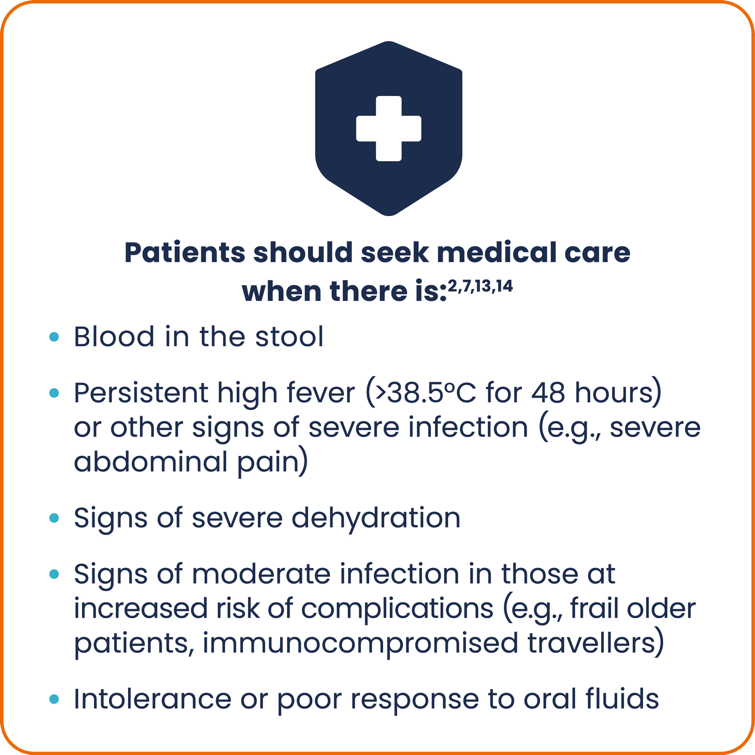
In moderate-to-severe cases, antibiotic therapy may be indicated, but self-treatment (i.e., providing a stand-by prescription to the patient) should be approached with caution – appropriate use relies on accurate self-diagnosis by the patient and there is a high potential for misuse.2 Prescribe stand-by antibiotics only for high-risk travellers visiting areas with limited medical access, and reinforce the importance of rehydration with an ORS.2
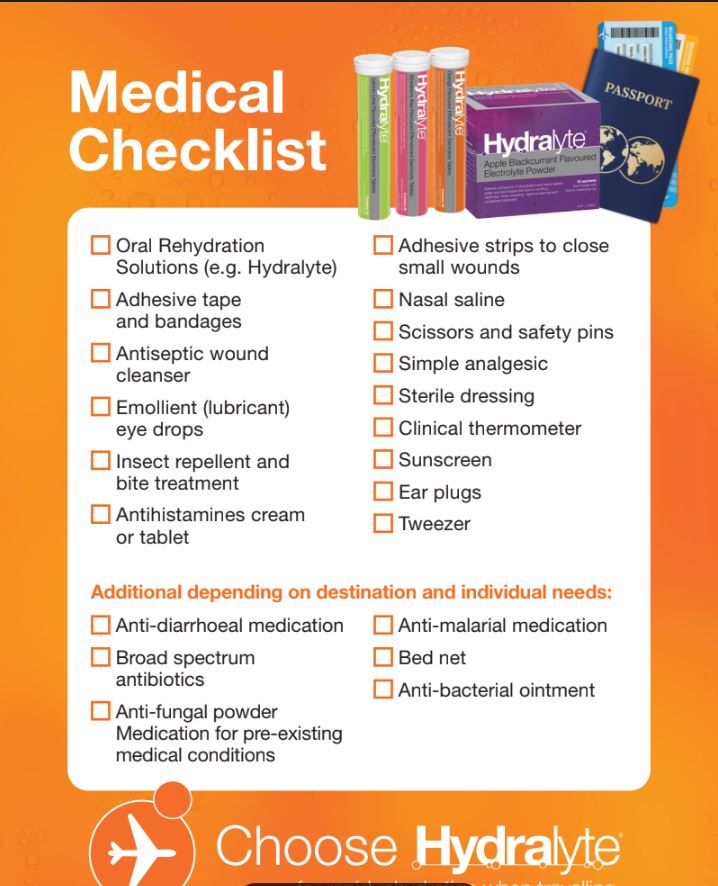
Download a Travel Health Checklist for patients
A quick packing guide of medicines and other health essentials when traveling internationally
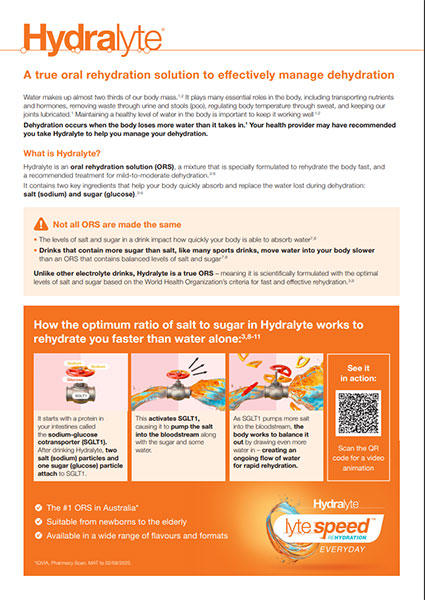
Download the Hydralyte Patient Leaflet
A helpful summary for patients explaining what an ORS is and the different Hydralyte options available
To download this resource, please login or register.
COVID, coronavirus disease; GP, general practitioner.
References:
- Australian Bureau of Statistics. Overseas arrivals and departures, Australia – 2024-25 financial year. Released 14 August 2025.
Available from: https://www.abs.gov.au/articles/overseas-arrivals-and-departures-australia-2024-25-financial-year (accessed October 2025). - Travellers’ diarrhoea [published 2025 Mar]. In: Therapeutic Guidelines. Melbourne: Therapeutic Guidelines Limited; accessed October 2025. https://www.tg.org.au.
- Carroll SC, et al. J Travel Med. 2025;32(2):taae008.
- Angelo KM, et al. J Travel Med. 2017;24(5):10.1093/jtm/tax046.
- Centers for Disease Control Yellow Book. Travelers’ diarrhea. Published 23 April 2025. Available from: https://www.cdc.gov/yellow-book/hcp/preparing-international-travelers/travelers-diarrhea.html (accessed October 2025).
- World Health Organization. Diarrhoeal disease. Published 7 March 2024. Available from: https://www.who.int/news-room/fact-sheets/detail/diarrhoeal-disease (accessed October 2025).
- Leder K. Aust Fam Physician. 2015;44(1–2):34–37.
- Steffen R, et al. JAMA. 2015;313(1):71–80.
- Steffen R. J Travel Med. 2017;24(1):S2–S5.
- National Institute for Health and Care Excellence. Diarrhoea – prevention and advice for travellers: What are the risk factors for travellers’ diarrhoea? Revised September 2023. Available from: https://cks.nice.org.uk/topics/diarrhoea-prevention-advice-for-travellers/background-information/risk-factors/ (accessed October 2025).
- Wright EM, et al. J Intern Med. 2007;261(1):32–43.
- Jeukendrup AE, et al. Nutr Metabl (Lond). 2009;6:9.
- Rehydration for acute gastroenteritis in children [published 2022 Aug]. In: Therapeutic Guidelines. Melbourne: Therapeutic Guidelines Limited; accessed October 2025. https://www.tg.org.au.
- Rehydration for acute gastroenteritis in adults [published 2022 Aug]. In: Therapeutic Guidelines. Melbourne: Therapeutic Guidelines Limited; accessed October 2025. https://www.tg.org.au.
- Campbell N. Nursing Times. 2014;110(46):20–21.
- World Health Organization (WHO). Oral rehydration salts. Production of the new ORS. 2006. Available at: https://www.who.int/maternal_child_adolescent/documents/fch_cah_06_1/en/ (accessed October 2025).
- Other supportive therapy and considerations for acute gastroenteritis [published 2022 Aug]. In: Therapeutic Guidelines. Melbourne: Therapeutic Guidelines Limited; accessed October 2025. https://www.tg.org.au.
©Care Pharmaceuticals 2025. Hydralyte® is a registered trademark of Care Pharmaceuticals. All rights reserved. November 2025.
This information is intended for use by healthcare professionals only.