Rectal Health
21.11.2025
Sip to stand: why hydration is essential in POTS

Postural orthostatic tachycardia syndrome (POTS) has gained increasing attention in recent years, particularly in the wake of the coronavirus disease 2019 (COVID-19) pandemic.1,2 Autonomic dysfunction is common in patients with long COVID – in one Australian cohort, 79% of patients with post-acute sequelae of COVID met the diagnostic criteria for POTS.1,2
For general practitioners, this translates into more patients presenting with light-headedness, palpitations, fatigue, or exercise intolerance.3–5 While diagnosis and ongoing management can be complex, the foundations of care are simple and supported by evidence: hydration and salt loading.3–5 Read on for an overview of the roles of hydration and salt loading in POTS management.
What is POTS?
POTS is defined as a sustained increase in heart rate of at least 30 beats per minute (bpm) within 10 minutes of standing (or 40 bpm in adolescents), in the absence of orthostatic hypotension.3–5
POTS is thought to arise from autonomic nervous system dysfunction, resulting in impaired vasoconstriction and abnormal blood pooling in the lower limbs when upright.6 This leads to a compensatory tachycardia as the body attempts to maintain cardiac output.6,7 While the exact cause is unclear, proposed mechanisms include hypovolaemia, hyperadrenergic state, neuropathic dysfunction, and autoimmune processes.6,7
In many cases, onset follows a triggering event such as a viral infection, physical trauma (e.g., concussion), menarche, pregnancy, or surgery.8 POTS typically affects younger women and represents approximately 85–90% of diagnosed cases, with symptom onset often in adolescence or early adulthood.3,7 Recent evidence has highlighted a strong association between POTS and long COVID, which share similar autonomic features.1,2
Patients may experience a broad spectrum of symptoms, reflecting both orthostatic intolerance and autonomic dysfunction.3–5
Orthostatic symptoms (triggered or worsened by standing)3–5
- Light-headedness
- Palpitations
- Tremulousness
- Atypical chest discomfor
Non-orthostatic or systemic symptoms3–5
- Chronic fatigue
- Sleep disturbance
- Exercise intolerance or deconditioning
- Perceived cognitive impairment (‘brain fog’)
- Headaches
- Gastrointestinal disturbance (e.g., bloating, nausea, or alternating bowel habits)
The burden of functional impairment can be considerable, with many patients reporting reduced social engagement, impaired ability to undertake usual activities, impact on employment, as well as low quality of life.2,9 Though there is currently no curative treatment, symptoms can be improved and managed with lifestyle-based strategies, and supportive pharmacotherapy if lifestyle measures are insufficient.3–5
Hydration and salt loading for managing POTS
For many patients with POTS, low circulating blood volume contributes to orthostatic symptoms.6,7 Maintaining adequate hydration helps increase plasma volume and thus improves orthostatic tolerance.6 Current recommendations include consuming 2–3 litres of fluid per day for adults with POTS.3–5 However, water alone is not sufficient to achieve adequate hydration.6
Salt loading is another strategy for expanding the intravascular volume, which increases the osmotic pressure in the intravascular space to help retain fluids.3–6,10 Evidence shows salt supplementation improves orthostatic tolerance, and may improve symptoms such as light-headedness, brain fog, and palpitations.10,11 The recommended sodium intake is approximately 4000 mg per day, provided there are no contraindications.3–5 Patients can increase sodium intake up to 10 g daily through diet or salt tablets.4,5
The role of an oral rehydration solution
Hydration can be achieved orally or intravenously (or a combination of both), but oral administration is usually more convenient.6 The World Health Organization (WHO) recommends oral rehydration solutions (ORS) for treating dehydration in acute diarrhoeal illness, and similar hydration approaches have been applied to orthostatic conditions like POTS given the presence of sodium and other electrolytes necessary for fluid retainment.6,12
A true ORS is scientifically formulated with an optimal ratio of sodium and glucose, designed to activate the sodium-glucose co-transporter (SGLT1) in the intestinal lumen.12–15 This creates an osmotic gradient that enhances water and sodium absorption, resulting in faster and more effective rehydration than water alone.12–16
Commercially available ORS preparations also offer a palatable and convenient alternative to salt tablets, which are sometimes poorly tolerated and may cause gastrointestinal discomfort due to the sudden increase in osmotic load.7
It is important to advise patients that not all electrolyte drinks are equivalent — many sports or ‘hydration’ beverages contain more glucose than sodium, reducing their efficacy.12,17 Recommending a true ORS, such as Hydralyte, ensures patients achieve effective and physiologically balanced rehydration.
Practical hydration strategies for patients
Advise patients with POTS to incorporate hydration strategies into their daily routines, such as:
- Distribute fluid intake throughout the day rather than consuming large volumes at once6
- Increase fluid intake in advance of exertion, hot weather, or prolonged standing
- Create a drinking schedule to build habits:
- start the day with a glass of water or ORS
- carry a refillable bottle of water or ready-to-use ORS during the day
- set phone alarms or reminders for regular drinking
- track intake using apps or simple logs
- Make fluids more palatable by switching up flavours and formats of ORS. For patients who struggle with large volumes of liquids, ice blocks are an option
Finally, while hydration and salt loading are vital strategies in POTS, they should form part of a broader management plan that may also include compression garments, graded exercise, withdrawing medications that may exacerbate orthostatic symptoms, and trialling medications that support blood pressure and/or help control heart rate where appropriate.3–5 Given the complexity of POTS, a multidisciplinary approach may help optimise long-term outcomes and quality of life.3,4
Watch Hydralyte in action
View an animated video that helps to explain the mechanism of action of oral rehydration solutions
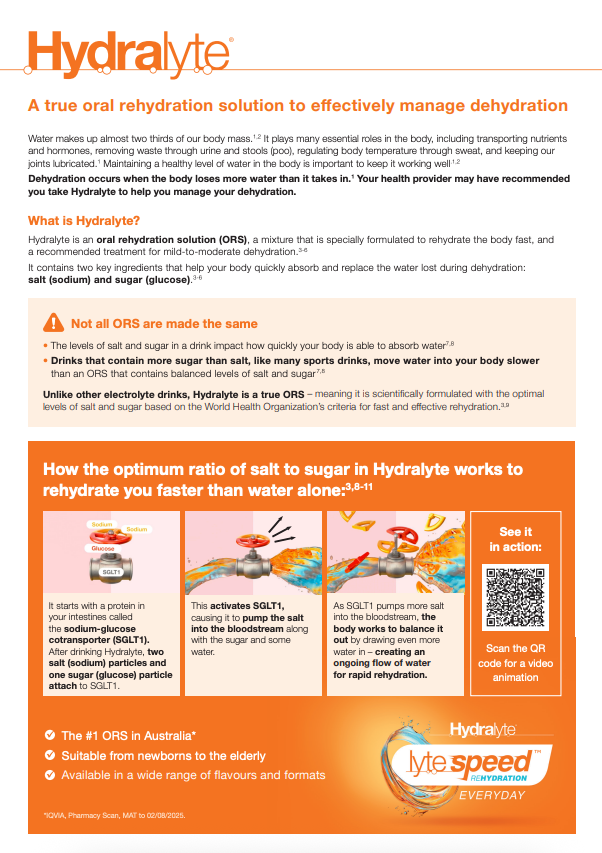
Download the Hydralyte Patient Leaflet
A helpful summary for patients explaining what an ORS is and the different Hydralyte options available
To download this resource, please login or register.
References:
- Hira R, et al. Can J Cardio. 2023;39(6):767–775.
- Seeley MC, et al. Am J Med. 2025;138(2):354–361.e1.
- Australian POTS Foundation. GP resource sheet. Available from: https://potsfoundation.org.au/wp-content/uploads/2025/08/GP-Resource-Sheet-2025.pdf(accessed October 2025).
- Raj SR, et al. Can J Cardio. 2020;36(3):357–372.
- Sheldon RS, et al. Heart Rhythm. 2015;12(6):e41–e63.
- Snapper H, Cheshire WP. Auton Neurosci. 2022;238:102951.
- Mar PL, Raj SR. Annu Rev Med. 2020;71:235–248.
- Vernino S, et al. Auton Neurosci. 2021;235:102828.
- Seeley MC, et al. Med J Aust. 2025;223(3):159–160.
- Williams EL, et al. Auton Neurosci. 2022;237:102906.
- Garland EM, et al. J Am Coll Cardiol. 2021;77(17):2174–2184.
- World Health Organization (WHO). Oral rehydration salts. Production of the new ORS. 2006. Available: https://www.who.int/maternal_child_adolescent/documents/fch_cah_06_1/en/ (accessed October 2025).
- Wright EM, et al. J Intern Med. 2007;261(1):32–43.
- Kellett GL, Helliwell PA. Biochem J. 2000;350:155–162.
- Zeuthen T, et al. J Physiol. 2001;531(Pt 3):631–644.
- Jeukendrup AE, et al. Nutr Metabl (Lond). 2009;6:9.
- Freedman S. Oral Rehydration therapy. In: UpToDate, Mattoo TK, Stack AM, Hoppin AG (Eds), Wolters Kluwer (updated 6 August 2025, accessed October 2025).
©Care Pharmaceuticals 2025. Hydralyte® and Rectogesic® are registered trademarks of Care Pharmaceuticals. All rights reserved. October 2025.
This information is intended for use by healthcare professionals only.